최종 업데이트: 2026년 4월 6일 | 5년+ 검증 경험 | 1,500+ 검증된 사이트 | 10만+ 사용자 신뢰
토토사이트 2026 - 검증된 안전한 베팅 플랫폼 완전 가이드
토토사이트를 찾고 계신가요? 2026년 현재, 온라인 베팅 시장은 급속히 성장하고 있으며, 수많은 토토사이트가 존재합니다. 그러나 그 중에서도 안전하고 검증된 사이트를 선택하는 것은 매우 중요합니다. 사기사이트, 먹튀사이트, 출금 지연等问题으로 인해 많은 이용자들이 피해를 보는 것이 현실입니다.
본 가이드는 2026년 최신 토토사이트 정보를 바탕으로, 검증된 안전한 메이저사이트를 엄선하여 소개하고, 사이트 선택 시 반드시 확인해야 할 보안 요소, 보너스 활용법, 입출금 과정 등을 상세히 설명드립니다.
Disclaimer: The Eqbal Ahmad Centre for Public Education (EACPE) encourages critical and independent thinking and believes in a free expression of one’s opinion. However, the views expressed in contributed articles are solely those of their respective authors and do not necessarily reflect the position or policy of the EACPE.
Pakistan never implemented a clear long-term policy to tackle the ever increasing gap in education amongst economic classes. By gap, I refer specifically to the quality of educational provisioning and how it differs as you climb up the socio-economic ladder.
A good place to start is Tariq Rahman’s Denizens of the Alien world which broke down the basic primary educational structure into four main categories: elitist schools, public schools, madressas and army managed cadet colleges. As the names suggest, the elite schools cater to the middle class and the upper class, charge expensively and educate in English. Quite cognizant of the state’s inability to provide standard education in the public schools, the army established their own lost-cost cadet schools to train “their wards” adequately. The madressas absorb the residual demand and take in children who are too poor to afford any of the above and/or have an inclination to acquire religious education interspersed with some western education basics.
The Annual Status of Education Report (2012) has expounded on these inequalities by dividing the population into four quartiles namely poorest, poorer, richer and richest. The results exhibited that the lowest household rung had the highest percentage of children enrolled in government schools at 91% and only 9% in private schools. The top quartile, on the contrary, had an alarming 40% enrolled in private schools and 60% in government schools. The report goes on to claim that a high correlation is found between wealth and enrollment in private schools, quite in line with Rahman’s analysis. Not so divergently, a high correlation is also found between learning levels (of Mathematics, English and Reading) and wealth.
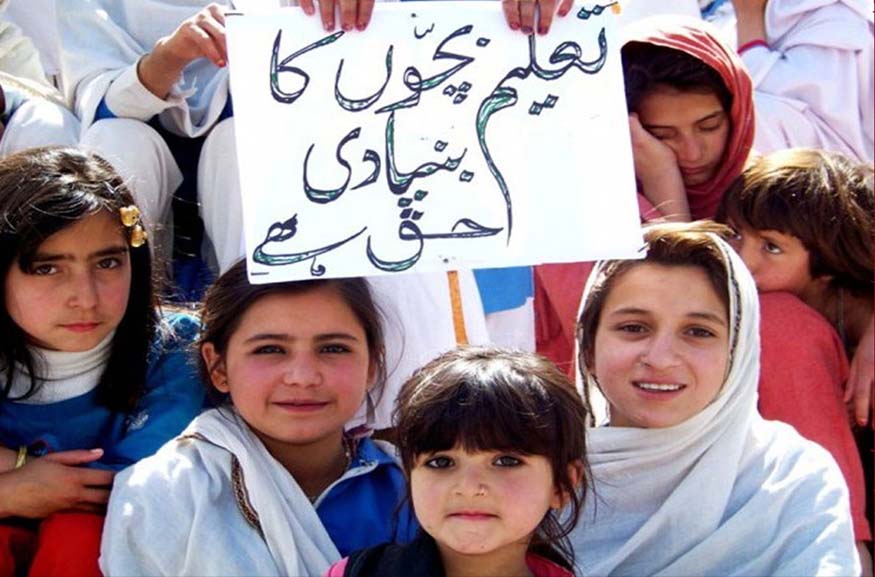
Educational may be a constitutionally endowed right but the rural poor, the few who do, have to walk kilometers to schools with no bathroom facilities and teachers who are no trained or motivated enough to pass on their limited knowledge.
According to Teach for Pakistan, a locally managed not-for-profit organization, 30% of Pakistanis suffer from extreme educational poverty (with less than two years of education) and half of the students completing primary school still suffer from functional illiteracy i.e. not being able to read a basic story or do basic addition and subtraction. According to UNESCO’s estimate, the economic impact of illiteracy (both absolute and functional) on Pakistan is $5.86 billion a year (~1.2% of GDP). Furthermore, in developing countries, a child born to a mother who can read is 50% more likely to survive past age five. The link between education and crime is also clear; estimates show that 60-80% of under-trial prisoners have reading and writing skills below basic levels.
Indeed, the gap in educational provisioning and the role it has in altering life possibilities is tremendous. Even if we ignore that meager 55% national literacy rate, even the ones that acquire primary schooling have very different futures ahead: some move on to elite secondary schools whilst most at the bottom learn nothing substantial from public schools. Combine the poor quality of learning, high indirect cost in form of lost child-labor wages and meager private returns from state-funded public education, the result you would get is a high-drop-out rate at primary level. National literacy is thus itself connected with the success of public schools.
Normative values dictate state intervention in favor of equality and better educational equilibriums. Xavier Rambla’s work on the education targeting policies adopted by Brazil, Argentina and Chile provide a great picture of how governments can target poverty through educational improvement. Though his analysis did not directly compare education across economic classes, it does delineate on the urban-rural differentials and the failure of public school setups as is the case with Pakistan.
Rambla defined education targeting as an “anti-poverty strategy … economic discrimination in favor of the poorest socio-economic status groups, in order to improve their performance, and reduce general inequality.” These programs tried to improve quality not only by restructuring school management but also freeing the child from the encumbrances of abject poverty and poor nutrition, which inhibit performance.
Argentina’s program of educational targeting was complemented with decentralization of education institutes to regional governments. In Brazil, the earlier reforms focused on increased enrollment via school based management but later on in the 90’s, pulled in grants for those students who hailed from poor families. The Chilean government acted no differently when it transferred school management to local authorities, offered pedagogical consultancy to school and aid to poor families.
But according to the Pakistan’s federal budget 2014-2015, the entire amount allocated to education is $ 0.64 billion (roughly 7% of what United States spends on pre-primary education alone). Furthermore, the difference in the quality and size of the public program can be judged by the fact that in the year 2009-2010, 34 million children attended 98,917 public elementary schools across the United States compared to only 12 million children who attended 138,000 public primary schools across Pakistan.
Though the count of public school in Pakistan may exceed over 130,000 across the four provinces but there is no guarantee whether these schools have adequate provisioning of electricity and water or whether they exist at all i.e. ghost schools. Building schools is not enough if they lack the infrastructure or are displaced from the population they cater to. Educational may be a constitutionally endowed right but the rural poor, the few who do, have to walk kilometers to schools with no bathroom facilities and teachers who are no trained or motivated enough to pass on their limited knowledge.
Yes, education changes life and this may be exactly why it is not focused upon in this country. It seems that change will come through the determination of the social sector than the “tamasha” of this Federation.