Bear with me. As I try to process it all.
He made me toast with pickled peppers on it.
This is what I keep coming back to. Not the geopolitics, not the Algerian Revolution, not the indictment that made headlines across America. The toast.
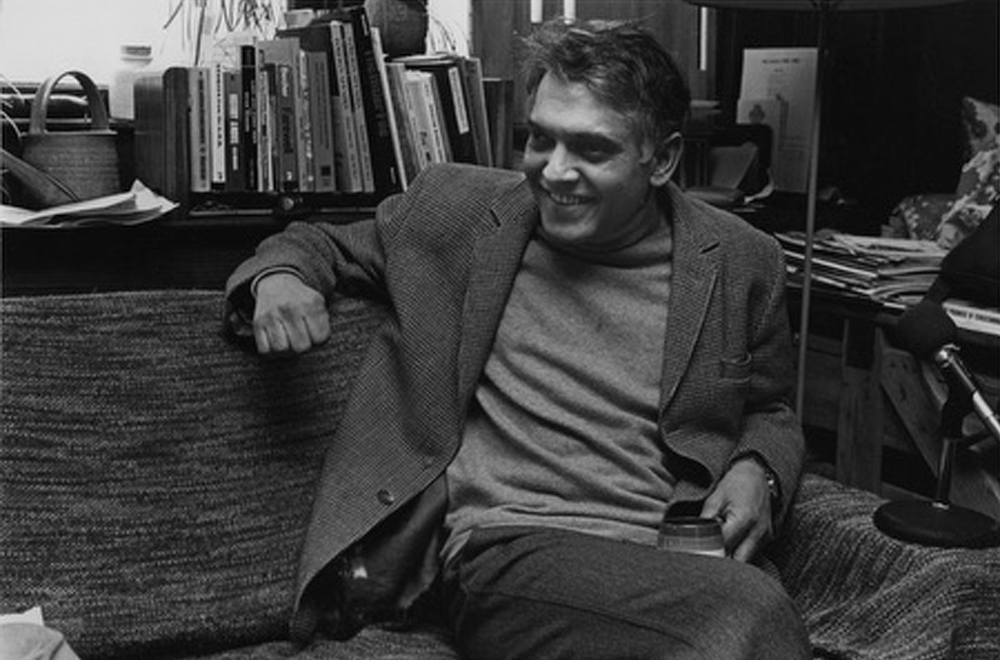
He lived on campus and so did I, and many a day and night I spent at his place — studying, arguing, listening, singing, hearing poetry, reading it aloud, being fed, growing up in front of him. That was Eqbal Ahmad. That was Hampshire College. The door was open, the conversation was long, and there was always something on the table.
I’d known him for as long as I can remember myself. From the days of Pakistan where he started mentoring me on politics with Raza Kazim. I was 9 when he made me first watch the Battle Of The Algiers. Which would watch a hundred times again in my life with my own students.
The news broke yesterday: Hampshire College will permanently close at the end of December 2026. The Board of Trustees voted after years of financial strain — declining enrollment, unrefinanceable debt, a land sale that fell through. For many of us, it is the second death. The first was Eqbal Ahmad, who died in Islamabad on May 11, 1999, following surgery for colon cancer.
I cannot separate the two losses. Hampshire and Eqbal were not just connected — they were, in some essential way, the same thing. The same refusal to accept the world as given. The same insistence that thinking is a form of action, that education without conscience is just credentialing.
How I Got There:
I didn’t want to go to college. At all. PI was a girl from Pakistan who wanted to become an actor — straight away, immediately, no detours. My parents and I had a huge fallout. They insisted on a degree I thought was useless. The argument went on and on.
And then Eqbal stepped in.
Why not try college and come? he said. It’s not going to be what you expect.
It wasn’t. Nothing about Hampshire was what I expected. I arrived — straight out of a convent school in Pakistan — into a clothing-optional hall. I was horrified. I learned, slowly, to be flexible, to coexist with points of view I had never encountered. I learned to accept others, and more surprisingly, myself. I used to prance around barefoot because Hampshire was a space that simply allowed you to be. No judgment. Even in the classroom, my feet would curl up onto the chair as I wrote and listened. There were drum circles. There were forests opening out into moonlit fields. There was Saga where we went to I’ll our crushes, make stir fry and wash dishes.
There were no grades — just the extraordinary challenge of presenting everything you had learned in the best, most honest way you possibly could.
I had come in as an art student. I thought I could only act, and that acting was all I needed. I left having done a Division III — Hampshire’s self-designed capstone degree — in political science with creative writing and political drama. Along the way I was taught economics, the sciences, climate, agriculture, archaeology. I remember a class on Native American Pueblo communities where we studied what their teeth revealed about how they lived and died. I studied improvisational jazz. I took classes at Smith, at Mount Holyoke, at UMass Amherst, at Amherst College — all woven together through the extraordinary Five College experience. I became someone I could not have imagined when I arrived. Prescott, Enfield, True Love, Not as true love, life long friendships, an education, a truly wholistic politically activated organic education and so much more. It’s all rushing past me. So is my brothers expression when he first visited me from uppity Tufts on a clothing optional hall, drum circle night. Someone had stolen the headlights from the roof again… for agricultural use in the dorm room… obviously.
I did not want to go to college.
Eqbal was the one who had called me there. And once I arrived, he became my supervisor, my teacher, my critic, my friend, my uncle. He tore up the first draft of my thesis and said, flatly: Nope. This is rubbish. Do it again. He taught me how to cite, how to research, how to put thoughts together with discipline. He taught me how to be even more political in my theatre. He taught me how to make my activism productive and resourceful. He taught me, most essentially, how to write.
My thesis was called Manto House — six essays on the contemporary consequences of the Partition of 1947 between India and Pakistan. The first had to be a political essay. The others could be short stories. The work was two-pronged: there was writing, and there was performance. I played Dionysus — in a production in the spirit of Richard Schechner’s radical environmental theatre adaptation of Euripides’ The Bacchae, a work that collapsed the distance between performer and audience, between art and political act. Eqbal understood exactly why that mattered.
He was knowledge. He was comfort. He was kindness. And on the many days I was down and needed nothing more than a friend, a cup of tea, someone to sit with — he was that too.
The Man Himself:
Eqbal Ahmad was born in 1933 in the village of Irki in Bihar, British India, to a family of Indian Muslim landowners. When he was a small boy, his father was murdered over a land dispute — in bed, as the boy lay next to him. He would cite this memory for the rest of his life whenever he spoke against the violence that lives inside the ownership of things. During the Partition of India in 1947, he and his elder brother migrated to Pakistan on foot, losing contact with family in New Delhi, arriving in Lahore carrying a gun.
He graduated from Forman Christian College in economics, served briefly as an army officer, and left for the United States in 1957 as a Rotary Fellow. He entered Princeton in 1958, studying political science and Middle Eastern history. But during his doctoral years, he went to North Africa — and North Africa changed everything.
In Tunisia, researching trade union movements for his dissertation, he befriended the leaders of the Algerian independence movement. One of them was Frantz Fanon — the revolutionary philosopher — in the last six months of his short life. Ahmad formally joined the FLN, Algeria’s National Liberation Front, providing logistical and intellectual support during the War of Independence. He was appointed to the Algerian Revolutionary Council. He helped research the script for The Battle of Algiers, Gillo Pontecorvo’s 1966 masterpiece that became the defining film of anti-colonial resistance, and was present on set while it was filmed. In Paris in 1961, he was arrested and beaten by French police for his ties to the movement.
Algeria shaped him, but it also sobered him. “After seeing what I saw in Algeria, I couldn’t romanticize armed struggle,” he later said. The Algerians had not won militarily — they had won morally, by isolating France in the eyes of the world. “The primary task of revolutionary struggle is to achieve the moral isolation of the adversary in its own eyes and in the eyes of the world.” This distinction — between the romance of violence and the discipline of moral politics — would define his thinking for the rest of his life.
Back in America, during the Vietnam War, he became one of the earliest and most vocal opponents of U.S. policy. In 1971, he was indicted as one of the Harrisburg Seven, charged with conspiring to kidnap Henry Kissinger to protest the war. Edward Said, his closest friend, later called it a trumped-up charge. Two thousand people protested at the Justice Department the day the indictments were handed down. After fifty-nine hours of deliberations, the jury declared a mistrial. He was acquitted of all charges in 1972.
His uncompromising politics kept him untenured for years — he paid a real professional price for the positions he held, and he held them anyway. In 1982, Hampshire College made him a tenured professor of politics and Middle Eastern studies. He taught there until 1997.
His closest friends were the great dissenting intellectuals of the era — Noam Chomsky, Howard Zinn, Tariq Ali. And above all, Edward Said, who would come to campus to visit him, who described him in his obituary as perhaps the shrewdest and most original anti-imperialist analyst of Asia and Africa, and who captured him in one unforgettable image: no one who saw him sitting barefoot and cross-legged on a living-room floor, conversing genially until the early hours, with a glass in his hand, will ever forget the sight — or the sound of his voice as he announced four major points, but never got past two or three.
He loved literature. He loved poetry. He loved, especially, ghazals. I used to sing for him — he would ask me to, and I could never say no. I remember once he was giving a lecture at the University of Massachusetts, a large hall packed with over a thousand students. He was on stage — Eqbal Ahmad, the historian Aisha Jalal, others — and mid-lecture he stopped, looked out into that enormous crowd, and called out:
Is Nadia Jamil in the hall? Nadia? Nadia, are you in the hall?
I was there. I raised my arm. Yes. I’m here.
Would you sing?
I wanted the floor to swallow me whole. But I could not say no to him. So in my thin, terrified voice, in front of a thousand strangers, I sang.
That was Eqbal. He believed that art and politics lived in the same body. He believed that a ghazal and a revolution were not so different in what they asked of you — full presence, full honesty, the willingness to be heard. He believed in present, in action and in arming oneself with knowledge, friendship or comrades & a good pickled pepper toast.
What Hampshire Was:
Hampshire College was founded in 1970 with a radical premise: that students should design their own education. No traditional grades. No fixed majors. No SAT scores required. The Division III — the self-directed capstone — was proof that you had learned not just content but how to think.
Hampshire attracted the ones who didn’t fit elsewhere. We were the odd ones. The ones who needed to be trusted to figure out what they were doing before they were asked to prove it.
For students like me — who arrived not knowing who they were, only knowing they didn’t belong anywhere yet — rebels without a cause… it was a lifeline.
I came in as an actor who thought she could only act. I left as someone who understood that acting, writing, politics, history, economics, and science are all part of the same urgent conversation about what kind of world we want to live in. I became a well-known actor in Pakistan. A Fellow of Shakespeare’s Globe Theatre in London. A television anchor and host. A master coach, a Master NLP and applied neuroscience practitioner, a hypnotherapist. I have given three TEDx talks, and I know the journey is only beginning. And it always starts from my heart. Every thread of that life runs back to Hampshire. Every thread runs back to Eqbal.
Hampshire was a place where I found friendship. Where I found love. Where a barefoot girl from Lahore could walk into a drum circle, argue about Partition in a political science seminar, sing a ghazal in front of a thousand strangers, and slowly, slowly, become herself.
Hampshire College is closing. The board made that announcement this week. They tried — they really tried, raising $55 million in a desperate 2019 campaign to stay alive, rebuilding enrollment, leaving no stone unturned. It wasn’t enough. December 2026 will be the last month Hampshire College exists.
I am sad for the students there now. I am sad for the faculty. I am sad for all the future students who will look for this place and find it gone, who will never know what they’re missing. I am sad for my children, and their children.
And yet.
Edward Said wrote of Eqbal that he managed to preserve his native Muslim tradition without succumbing to frozen exclusivism — that humanity and secularism had no finer champion. I think the same could be said of Hampshire. It held its radical idealism for over fifty years without calcifying, without becoming a parody of itself, genuinely committed to the idea that education is a form of becoming.
Both are gone now. But what they made in the people they touched — that doesn’t close. Ever.
I am so very grateful. What a privilege it has been to be even a tiny atom, a wee part of this incredible legacy. What an extraordinary, improbable privilege — to have been called there by a man who believed in me before I believed in myself, who tore up my bad work and fed me toast with pickled peppers and asked me to sing in front of a thousand people and taught me that politics and poetry are not opposites but the same reaching — toward justice, toward honesty, toward the world as it could be.
Both are gone now. Eqbal Ahmad & his beloved comrade Raza Kazim. Two of the greatest intellectuals Pakistan ever had. But what they made in the people they touched — that doesn’t close.
What a blessing to have been taught by them, to have grown up in their shadow. May their next journeys be full of the peace, beauty & passion, the love they were full of in this life. In peace.
The captain of my ship was Eqbal.
And my ship was Hampshire.
About the Writer: Nadia Jamil studied at Hampshire College, where Professor Eqbal Ahmad supervised her Division III. She is a British Pakistani actor, activist, and writer based in Lahore, Pakistan.