
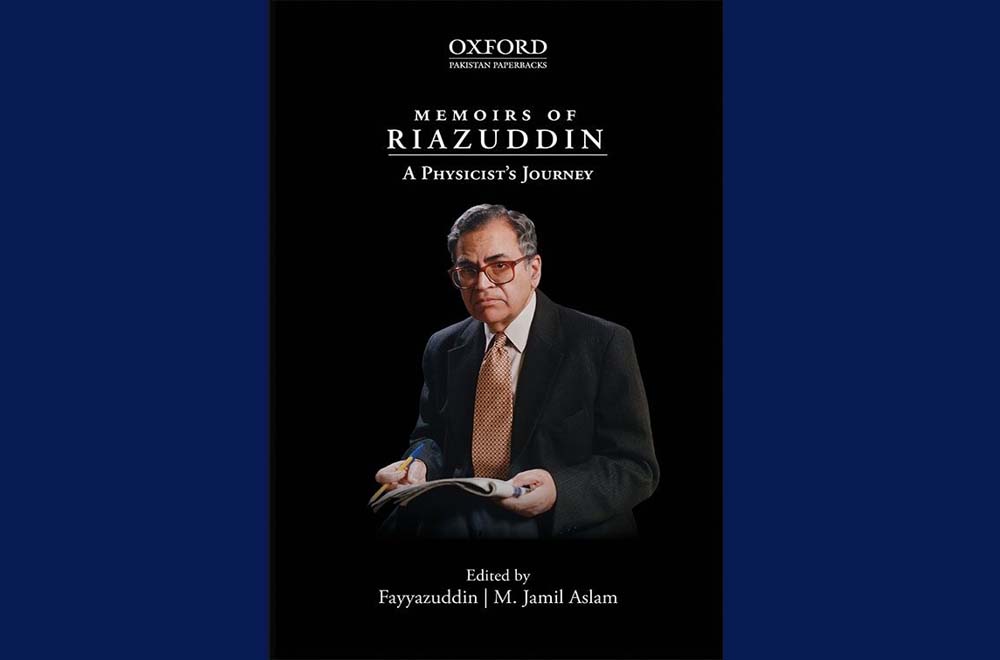
These are the bare bones of a memoir, straightforwardly related and bereft of emotion, detail, or humour. If you are looking for literary finery, go elsewhere. This slim volume comes from a self-effacing man so soft spoken that just to hear him you sometimes had to lean forward. His full name was Riazuddin, a single word appropriate for a man of very few words; in fact, so few that apart from those who interacted with him scarcely has a Pakistani heard of him. When he passed away in 2013 in Islamabad at age 82, his death merited no more than a few newspaper lines and a small reference meeting at the Physics Department of Quaid-i-Azam University – of which he was the founder. Today nothing in that department, or in the nearby National Centre for Physics that he also founded, stands in memory.
Why, then, should one read his rather dull memoirs? The simple answer is: it’s because of who Riazuddin was. And, equally, because of the stories he has to tell – ones that none but he could have told.
It can be fairly said that in Pakistan’s entire 74 years of history, the world of highly sophisticated science has known only two Pakistanis. One, of course, is Abdus Salam. The other is Riazuddin, who received his PhD in physics under Salam from the University of Cambridge. On his thesis committee was the famous astrophysicist, Sir Fred Hoyle, the first to discover how stars generate energy. Theirs was the world of high-brow top-notch physics – that which uses sophisticated mathematical tools to study the subatomic constituents of matter and the deep laws of nature. Upon Riazuddin’s death, leading science news journals across the world carried obituaries as some of the high priests of particle physics paid homage – a rare honour not accorded to any other Pakistani except Salam.
For the 1970s’ generation of physicists, Riazuddin’s book Theory of Weak Interactions in Particle Physics (coauthored with CP Ryan and Robert E Marshak) was something of a bible. It was a reference work that carried everything that was important in that then-new and difficult field. Since those times much has changed and superstrings have led to revolutionary new insights into the nature of matter. Nevertheless another major achievement of Riazuddin – known as the KSFR relation – remains astonishingly relevant today and one still does not understand why it works so well. In that equation R stands for Riazuddin while F is for Fayyazuddin, his identical twin brother and co-editor of these Memoirs.
Sometime in 1970, while I was a sophomore at MIT and had barely crossed twenty, a physics professor learned that I was from Pakistan. Did I know Riazuddin, he asked? No, I had not heard the name. Little did I know that just three years later I would be his junior colleague at Quaid-i-Azam University, then known as the University of Islamabad. Nor could I have known that just around then he had been secretly tasked to design Pakistan’s atomic bomb. In 1999, a year after Pakistan tested six nuclear devices, Riazuddin received Pakistan’s highest civil award, the Hilal-i-Pakistan.
From Ludhiana to Lahore
Born in Ludhiana in 1930, it was easy to mistake Riazuddin for Fayyazuddin – and vice versa. Like other lower middle class Muslim children living in a religiously divided community, they attended the Islamia High School run by the Anjuman-i-Islamia philanthropy. Muslims in united India from Mughal times had no tradition of scholarly learning and were both English-averse and science-averse. This school had no notable alumni. It was similar to the town’s single public and two Hindu-run schools. Nothing suggested that these two boys squatting on floor mats, laboriously writing Urdu alphabets on wooden tablets were to become anything special.
In March 1947, as the creation of Pakistan drew close, communal riots bloodied the Punjab. From these sparse memoirs we learn little of those terrible times except for a single line – that the family entered Pakistan from the Wagha border in early October. Like so many other refugees they came empty-handed. The boys enrolled at Lahore’s MAO College but soon moved to Government College where they performed well but not spectacularly so. A teacher suggested that Riazuddin study physics rather than engineering. Riazuddin agreed and Fayyazuddin followed.
This rather uninteresting situation changed dramatically in 1951 when Salam came to town. Then twenty five, Salam was a rising star in the world of high-brow physics having just solved an important problem in quantum field theory, a newly emerging subject that was beyond the comprehension of all but the elite among physicists of the time. For his research on “overlapping divergences”, Salam was awarded the Adams Prize and offered a professorship at Cambridge University. He declined the offer and signed up instead as a professor of mathematics at Government College.
In Lahore, one of Salam’s first initiatives was to introduce a course in quantum mechanics at Punjab University. Drawn by his reputation, students flocked to it but only Riazuddin and Fayyazuddin could survive the tough mathematics involved. A disheartened Salam never taught the course again. But he had already identified the twins to be the best and brightest of those he encountered. Riazuddin was later invited to become his PhD student at Cambridge. Helped by Salam, Fayyazuddin went to Imperial College, London, a couple of years later.
The bomb years
Weeks after the fall of Dacca in December 1971, Bhutto held a meeting in Multan where he invited Pakistani scientists to make a nuclear weapon. It was to avenge national humiliation and ensure that India would never attack Pakistan ever again. Abdus Salam was present at the meeting as was Fayyazuddin but Riazuddin was then abroad. None of those who had gathered there had any kind of weapons experience, including Salam.
Nevertheless, Bhutto had clearly invited some of the right people. Thirty years earlier the first nuclear bomb had been conceived and designed by world’s finest theoretical physicists. It was then a stunning demonstration of the power of physics and mathematics. However with the passage of time, understanding the nuclear chain reaction was no longer the mystery it had once been. More and more nations would become capable of making bombs. North Korea is the latest and Iran can easily do so unless external forces move to stop it.
These otherwise dry Memoirs provide invaluable insight into how Pakistan began its pursuit of the bomb. After Fayyazuddin briefed his brother, Riazuddin was summoned by Salam in early 1973 to Trieste (Italy) at the International Centre for Theoretical Physics. He was the only physicist living in Pakistan with the physics/mathematics background and capability to accomplish this task. Salam instructed him to meet with Munir Ahmad Khan, chairman of the Pakistan Atomic Energy Commission, in Islamabad. Also, he was told to start theoretical investigations relevant to bomb physics. Immediately thereafter, Riazuddin began studying the Manhattan Project Report. This contained critical information of the United States 1940s’ effort to develop atomic bombs, those which were subsequently dropped on Hiroshima and Nagasaki in 1945. The secret document had by then been declassified by the US government. Absorbing various books and other nuclear physics papers, Riazuddin quickly moved up the learning curve.
I cannot repeat here in entirety my obituary article of 2013, The Man Who Designed Pakistan’s Bomb Just Died – And Nobody Noticed. It was based upon preliminary parts of the Memoirs that Riazuddin had provided to me before his death, as well as information from Fayyazuddin and other sources. He reached out to me in spite of my being on the opposite side – that which opposes the acquisition of nuclear weapons by every country, including Pakistan.
In a nutshell, using the technical literature and adding in certain parts of his own knowledge, Riazuddin did seminal calculations for designing a nuclear device. He found out how to use just the smallest possible amount (about 20 kg) of the then extremely scarce U-235 material, worked on a mechanism for triggering the bomb, and calculated the explosive yield for a variety of theoretical designs. He did not do this alone. Instead he created a group around himself that included his former PhD student, Masud Ahmad. The rest of the effort needed engineering support. Much of this came from the help that the Chinese provided.
Some would argue that Pakistan would have got the bomb regardless of Riazuddin and his group. That is probably true, but it would have been delayed and dependence on the Chinese would have been still greater. In October 2003 the Americans had confiscated centrifuges and detailed nuclear weapon drawings with Chinese inscriptions when they intercepted the Libya-bound ship BBC Cargo. Subsequently, Gen Musharraf made Dr AQ Khan apologise publicly on PTV for having engaged in nuclear smuggling.
I personally was unsurprised by the China connection. In fact, around 1994 or 1995, Munir Ahmad Khan – who by then had retired as PAEC chairman – had whispered this to me under conditions of strict confidentiality. As we sipped tea in his drawing room, he said that two visiting American senators had angrily told him that the United States was fully aware of Pakistan’s possession of detailed Chinese help as well as bomb blueprints and drawings. To show that he had proof, one senator threw down a sheaf of drawings on the sofa in response to Khan’s denials.
There is a second reason why we should be grateful that Riazuddin picked up a pen to write about himself towards the end of his life. He was able to show that things could actually be made to work in Pakistan and also to point out why they eventually fell apart.
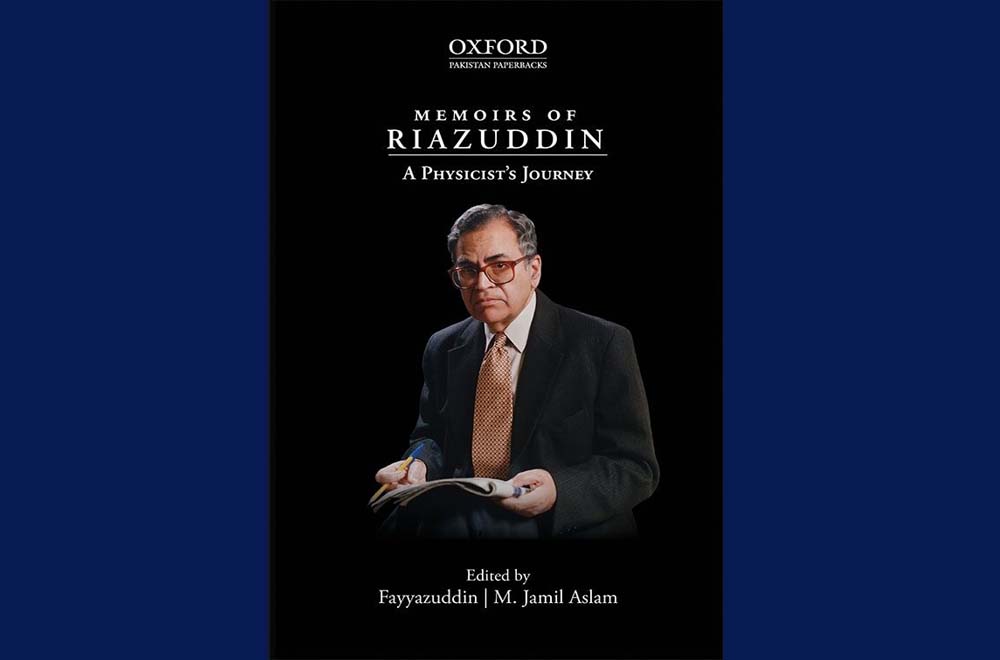 Memoirs of Riazuddin – A Physicist’s Journey