




 John Scales Avery is a theoretical chemist at the University of Copenhagen. He is noted for his books and research publications in quantum chemistry, thermodynamics, evolution, and history of science. His 2003 book Information Theory and Evolution set forth the view that the phenomenon of life, including its origin, evolution, as well as human cultural evolution, has its background situated in the fields of thermodynamics, statistical mechanics, and information theory. Since 1990 he has been the Chairman of the Danish National Group of Pugwash Conferences on Science and World Affairs. Between 2004 and 2015 he also served as Chairman of the Danish Peace Academy. He founded the Journal of Bioenergetics and Biomembranes, and was for many years its Managing Editor. He also served as Technical Advisor to the World Health Organization, Regional Office for Europe (1988-1997).
BOOKS
A complete list of books is given at the end of this section. Find below the description of some of the books authored by John Scales Avery.
Literacy
From the birth of writing to the rise of civilization, literacy paved the way for human progress. Read it here.
Lives Of Some Great Ethical Teachers
This captivating book offers a compelling compilation of life stories from visionary minds such as Tolstoy, Einstein, Martin Luther King, and Bertrand Russell. Delve into the lives of these influential ethical teachers, uncovering their wisdom, insights, and timeless contributions that continue to shape our world today. Read it here.
Lives in Acting
This book is part of a series on human history as cultural history written by John Scales Avery. Read it here.
Trying to Predict the Future
It’s hard to make predictions, especially about the future. How can we try to accomplish this difficult task? Read it here.
Lives of Classical Composers
This book is part of a series on human history as cultural history. Read it here.
Iran, Past and Present
Iran: From the empire of the Medes to the death of Masha Amini and the author’s personal memories. Read it here.
Lives of Some Great Philosophers
The millennia-long accumulation of knowledge and culture is a much more important part of human history than the wars and power struggles of rulers and national governments. Read it here.
We Are Demanding Too Much
We are demanding more from nature than nature can restore. Read it here.
Against Nationalism
Today, in an era of all-destroying nuclear weapons, instantaneous global communication and worldwide economic interdependence, nationalism has become a dangerous anachronism. Read it here.
Lives of Some Great Film Directors
This book is part of a series on human history as cultural history. Read it here.
Steps Towards Avoiding a Climate Catastrophe
There is clear evidence that climate-related threats are becoming more severe. What are we to do? What actions can we take to avoid a climate catastrophe? Read it here.
Reforming the United Nations
Probably our best hope for the future lies in developing the United Nations into a World Federation. Read it here.
Lives in Molecular Biology
This book is part of a series on human history as cultural history. Read it here.
Famine, Disease and War
Among the positive checks to population growth, are the three terrible Malthusian forces, famine, disease and war. Read it here.
Sacrificing the Earth for the Economy
The people of the world must wake up to the dangers of catastrophic climate change, and put as much pressure on our governments as possible to stop sacrificing the earth on the altar of economics. Read it here.
Selling Weapons, Selling War
No flag has ever been wide enough to cover up atrocities of war. Today, the development of all-destroying modern weapons has put war completely beyond the bounds of sanity and elementary humanity. Read it here.
Lives of Some Great Dramatists
This book is part of a series on cultural history. The dramatists whose lives and work are discussed here are those best known to the western world. Read it here.
Homo sapiens?
Humans, in their arrogance, call themselves not just “Homo sapiens”, but “Homo sapiens sapiens”, the “wisest of the wise”! Admittedly, our species has enormous technical and scientific progress to its credit, as well as great cultural achievements. But wisdom? Wisdom is another matter entirely. Our suicidal wars against nature and against each other can hardly be called wise. Read it here.
Lives in Prehistory
We need to reform our teaching of history so that the emphasis will be placed on the gradual growth of human culture and knowledge, a growth to which all nations and ethnic groups have contributed. Read it here.
Lives in the Middle Ages
It is important to remember that the Middle Ages were years of great scientific and cultural progress for the Islamic world, and for China and India. Read it here.
Corporations Versus Democracy
Greed and lack of ethics are built into the structure of corporations. The enormous and universal power of corporate oligarchs undermines democracy. Read it here.
Lives in the Renaissance
We need to reform our teaching of history so that the emphasis will be placed on the gradual growth of human culture and knowledge, a growth to which all nations and ethnic groups have contributed. Read it here.
Warnings from the Poles
Warning signs from both the Arctic and the Antarctic tell us that we must take urgent action to stop the use of fossil fuels and to replace these energy sources with renewable energy. Read it here.
Lives in the 20th Century
We need to reform our teaching of history so that the emphasis will be placed on the gradual growth of human culture and knowledge, a growth to which all nations and ethnic groups have contributed. Read it here.
Humanity’s Massive Footprint on the Face of Nature
If catastrophic climate change is not avoided, most parts of the earth will become uninhabitable. Read it here.
Lives in the 17th Century
After ‘Lives in the 18th Century‘ and ‘Lives in the 19th Century‘ here comes ‘Lives in the 17th Century’. This book is part of a series on cultural history. Read it here.
Tasks for the Future
We give our children loving care, but it makes no sense do so and at the same time to neglect to do all that is within our power to ensure that they and their descendants will inherit an earth in which they can survive. We also have a responsibility to all the other living organisms with which we share the gift of life. Read it here.
Lives in the Ancient World
Discover the breadth and depth of human history from its earliest beginnings through the Middle Ages. Read it here.
Money and Politics
If politicians continue to use money as a guide in making decisions, we will lose the battle to save human society and the biosphere from the catastrophic long term effects of climate change. Read it here.
Lives in the 18th Century
We need to reform our teaching of history so that the emphasis will be placed on the gradual growth of human culture and knowledge, a growth to which all nations and ethnic groups have contributed. Read it here.
We Need Immediate and Drastic Climate Action
Our planet is warming. Here’s what’s at stake if we don’t act now. Read it here.
Lives in the 19th Century
We need to reform our teaching of history so that the emphasis will be placed on the gradual growth of human culture and knowledge, a growth to which all nations and ethnic groups have contributed. Read it here.
Who is My Neighbor?
On our small but beautiful earth, made small by technology, made beautiful by nature, there is room for one group only – the family of humankind. Read it here.
Lives in Biology
In his latest book, John Scales Avery talks about the lives and works of some of the renowned novelists as a part of series on cultural history. Read it here.
Lives of Some Great Novelists
John Scales Avery talks about the lives and works of some of the renowned novelists as a part of series on cultural history. Read it here.
Why War?
Nuclear weapons are criminal! Every war is a crime! Can we not rid the world of these insane and antihuman weapons before everything of value in our beautiful world is reduced to radioactive ashes? Read it here.
A Critical Decade
Humanity is hurtling towards destruction unless we have the collective wisdom to change course quickly. Read it here.
The Social Responsibility of Scientists
We must educate our scientists in such a way that the acquisition of a sense of social responsibility will be part of their education. Read it here.
67 Years in the Peace Movement
John Scales Avery has a long history of working on causes of peace, economic equality, and helping us think of what a better world could look like. He is the author of many books, both on scientific and social-political issues. Here is compilation of some of the things that he has written. Read it here.
Water
The future well-being of human society depends on how we we manage our global supply of fresh water. This book by John Scales Avery discusses various aspects of the relationship of water with human society, and with all life on planet earth. Read it here.
The World as it is and the World as it could be
This book, in its original form, dates from 1983, and it was the first piece that John ever wrote about global problems. Following the suggestion of Hassan Fattahi, famous Iranian scientist and author, John has extended it to 12 chapters and 365 images, one for each day of the year. Read it here.
Lives in Mathematics
This book will be of interest to students of mathematics and other disciplines related to mathematics, such as theoretical physics and theoretical chemistry. Read it here.
Our Suicidal War Against Nature
We must urgently address the problem of climate change and we must shift money from military expenditure to the support of birth control programs and agricultural research. Read it here.
Madmen and Economists
In his latest book, John Scales Avery discusses the reasons for economists’ almost-religious belief in growth, and the impossibility of long-continued growth of anything physical on a finite planet. Read it here.
Adam Smith’s Invisible Hand is at Our Throats
Today, our greed-based, war addicted and growth-obsessed economic system poses even greater threats than it did during the early phases of the Industrial Revolution. Read it here.
Ethics for the Future
A society that is technologically advanced, but ethically primitive, will destroy itself. We need a global ethical system to match our technologically advanced global society. Read it here.
A History of the Earth
On our small but beautiful earth, made small by technology, made beautiful by nature, there is room for one group only: the family of humankind. Read it here.
The Road Not Taken
Although we might embrace our destiny, we sometimes think with regret on the road not taken, and wonder what might have been if we had chosen other paths. Read it here.
Ye Are Many, They Are Few!
This latest book by John Scales Avery addresses the question of how oligarchs maintain their grasp on an excessive share of wealth and power when, as Shelley points out, the have-nots are many, while the power-holders are few. Read it here.
Our World is Burning
Although the worst threats from catastrophic climate change lie in the long-term future, we are starting to see the effects of climate change today. The latest book by John Scales Avery. Read it here.
The Ecological Impact of Militarism
The survival of civilization can only be ensured if we are able to abolish destructive weapons and the institution of war. We must develop a new global ethic, which will replace our narrow loyalties by loyalty to humanity as a whole. Read it here.
Remembering the 1960’s
The 1960’s can inspire us today because as well as being a period of change, the decade was characterized by hope and optimism. We need hope. We need optimism. Read it here.
Some Aspects of Quantum Theory
This latest book by John Scales Avery will be of interest to students and researchers in mathematics, physics and theoretical chemistry. The book especially emphasizes the relativistic treatment of resonance energy transfer. Read it here.
Lives in Exploration
This book traces the history of how humans explored and settled in the entire earth, and in our own times even reached out farther, exploring the outermost parts of the solar system. Read it here.
Human Nature
Conflicting answers have been given by philosophers, scientists and religious leaders over the centuries about the human nature. These answers will be reviewed and discussed in this latest book by John Scales Avery. Read it here.
Malthus Revisited
Many people maintain that because both our food supply and the global population of humans have grown so enormously, Malthus was wrong. However, John Scales Avery believes that we still must listen to the warning voice of Malthus. Read it here.
Benefits of Equality
“If Trump is a symptom, what is the disease?” One often encounters this interesting question in alternative media articles. I think that at least part of the answer is “Excessive economic inequality”. Read it here.
Lives in Education
Education is an investment that gives dividends. The life of a knowledge worker is extremely interesting and rewarding. Read it here.
Rebuilding After Corona
It is hard to predict how long the terrible COVID-19 pandemic will last, but at some time in the future it will end. The post-pandemic world must be a new and changed world! Read it here.
Lives in Poetry
In this book, John Scales Avery presents an historical anthology of the poems of some of the world’s great poets, from very early times until the present, and from many countries and cultures. Read it here.
Linked Dangers to Civilization
In this book, John Scales Avery explores the following issues: dangers from COVID-19, catastrophic climate change, the danger of thermonuclear war, the danger of widespread famine, the global refugee crisis, the loss of democratic institutions, apocalyptic loss of biodiversity, and intolerable economic inequality. Read it here.
Lives in Painting
In his latest book, John Scales Avery shares the story of the lives and work of some of the world’s great painters, from earliest times to the present. Read it here.
Climate Change Means Lifestyle Change
This latest book by John Scales Avery deals with the world’s failure to adequately address the existential danger of catastrophic climate change. Read it here.
Lives in Engineering
Science and engineering have combined to give humans mastery over nature. This latest book by John Scales Avery traces that historical development, looking mainly at the contributions of engineering. Read it here.
Lives in Astronomy
The Earth may be just a small blue speck drifting in the dark immensity of space, but it is our home, and we must work with courage and dedication to care for it. Read it here.
Terrorism: A False Threat
This latest book by John Scales Avery deals with the terrible consequences of the so-called “War on Terror” which followed the 9/11 attacks. Read it here.
Fighting for America’s Soul
The book deals with the the current deep split in public opinion in the United States. Democratic institutions are in danger from racism and neo-fascism. Progressives are fighting to save the values and institutions on which their country was founded. They are fighting to save America’s soul. Read it here.
Lives in Chemistry
This latest book by John Scales Avery discusses lives in Chemistry and is part of a series on cultural history. Read it here.
The Passions of Mankind
This latest book by John Scales Avery discusses human emotions, seen from an evolutionary perspective. Read it here.
Lives in Medicine
This latest book by John Scales Avery makes use of articles and book chapters that he has previously and recently written about the history of medicine. Read it here.
Lives in Ecology
This book reviews the lives and thoughts of some of the women and men who have addressed the crucial problems of ecology and sustainability that we are currently facing. We need their voices today! Read it here.
Fascism, Then and Now
There are many extremely worrying similarities between fascism in Europe in the 1930’s and the neo-fascism that we can see around us today. Read it here.
Lives in Physics
This latest book by John Scales Avery aims to contribute to the goal of making the history of physics and its social impact available to a wide audience. Read it here.
Lives in Economics
In this book, the lives of some of the women and men who have contributed to economic thought are sketched. Their ideas can help us today, as the world faces a crisis that has both economic and ecological dimensions. Read it here.
Lives in the Peace Movement
It is not an impossible goal to think of enlarging the already-large groups of the modern world to include all of humanity. On our small but beautiful earth, made small by technology, made beautiful by nature, there is room for one group only: the all-inclusive family of humankind. Read it here.
We Need an Ecological Revolution
Since rapid and fundamental changes are urgently needed to save the future, it is perhaps not an exaggeration to speak of the need for an ecological revolution. However, it must be a non-violent revolution. Read it here.
Saving the Future
Only immediate climate action can save the future. If we don’t take action, the collapse of our civilizations and the extinction of much of the natural world is on the horizon. Read it here.
A World Federation
In order to save the world from destruction in a thermonuclear World War III, the United Nations Charter must be reformed and strengthened. Read it here.
Searching for Truth
This book is about our search for truth. How can we distinguish truth from falsehood in a world where government controlled and corporation controlled mass media use distractions, omissions, lies and propaganda to manipulate us? Read it here.
Population and the Environment
One hopes that human wisdom and ethics will continue to grow, but indefinite growth of population and industry on a finite earth is a logical impossibility. Read it here.
The Information Explosion
This book discusses the role of information in evolution, and especially in the evolution of human culture. Articles and book chapters that John Scales Avery has previously written on this subject are incorporated in the text in modified forms, but more than half of the material is new. Read it here.
The Devil’s Dynamo
It is a collection of articles and book chapters that John Scales Avery has written about the way in which military-industrial complexes throughout the world drive and perpetuate the institution of war. A considerable amount of new material has also been added. The book can be freely downloaded and circulated here.
Where Do We come From? What Are We? Where Are We Going?
Regardless of whether the earth has a special importance when viewed on the scale of our fathomless universe, it is certainly important to us, and to the plants and animals with which we share the gift of life. Read it here.
Ethics and Evolution
In his latest book, John Scales Avery discusses evolution, artificial life, religious opposition to evolution, horrors linked to social Darwinism, the need for human solidarity and more. Read it here.
Climate Change, Population Growth and Famine
Unless efforts are made to stabilize and ultimately reduce global population, there is a serious threat that climate change, population growth, and the end of the fossil fuel era could combine to produce a large-scale famine by the middle of the 21st century. Read it here.
Nuclear Weapons: An Absolute Evil
This book is a collection of articles and book chapters that John Scales Avery has written advocating the abolition of nuclear weapons. Some new material has also been added, for example a discussion of the Nuclear Weapons Convention which has recently been adopted by an overwhelming majority vote at the United Nations General Assembly. Read it here. Also, read a review on this book by Anne Baring here.
The Climate Emergency: Two Time Scales
In his latest book, John Scales Avery argues why is climate change an emergency and why quick change is needed to save the long-term future. Read it here.
Languages and Classification
John Scales Avery explains languages and their classification in his recent book. Read it here.
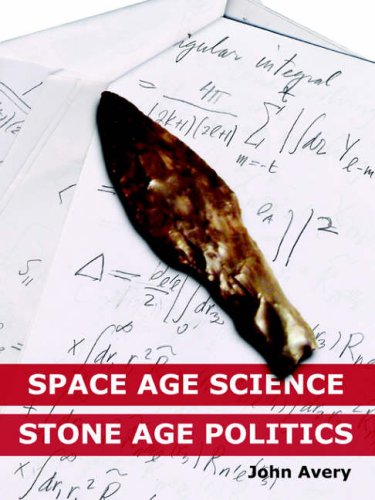
Space-Age Science and Stone-Age Politics
Looking beneath the surface of today’s news stories, we can discern an explosive mixture – Space  age science and stone age politics. This book discusses the tensions created by the rapid rate of scientific and technological change, contrasted with the slow rate of change of our political institutions. Because of the enourmous destructive power of modern weapons, and because of today’s instantaneous global communication, the institution of war has become a dangerous anachronism, and indeed the absolutely-sovereign nation-state has also become an anachronism. “Space-Age Science and Stone-Age Politics” discusses the steps we must take to harmonize our social and political institutions witht the constantly accelerating achievements of science and technology.
Read it here in English and here in Urdu. Shop it here.
CRISIS 21: Civilization’s Crisis in the 21st Century
This book describes the links between the serious problems that are facing the world today – threats to the environment, growing population coupled with vanishing resources, intolerable economic inequality and the threat of nuclear war – and it proposes holistic solutions.
Read it here. Shop it here.
We Need Their Voices Today!
This book is a collection of biographical sketches showing people whose wise voices from the past can help to guide us today. All of the women and men, brief glimpses of whose lives and ideas are portrayed here, gave a high place to compassion. None of them was a slave to greed. We need their voices today! Read it here.
Progress, Poverty and Population: Re-reading Condorcet, Godwin and Malthus
This work traces the history of a debate which took place among the economists, political philosophers and writers of the late 18th and early 19th centuries, about whether the benefits of scientific progress would be nullified by the growth of the global population.
Shop it here.
The Need for a New Economic System
It is clear that our present economic system is unsustainable. Never-ending exponential industrial growth on a finite planet is a logical absurdity. We are already using resources at a rate which it would take 1.6 planet earths to replace. We are already undermining the ecological systems which support all of life. Our present economic system has led to an unbelievable degree of economic inequality. To maintain this inequality, both between nations and within nations, military force is used, and democracy is replaced by oligarchy. The future of human civilization is endangered both by the threat of thermonuclear war and by the threat of catastrophic climate change; and both of the twin threats are results of our present economic system. This book documents in detail the serious economic problems of today’s world, and it also proposes sustainable solutions.
Read it here, and shop it here. Also, read a review on this book by Dr. Dorothy Guyot here.
Calculus and Differential Equations
This book describes the history of calculus and differential equations, and provides a set of worked problems for the reader interested in learning these subjects.
Shop it here (Paperback) and here (eBook).
Information Theory and Evolution
 This highly interdisciplinary book discusses the phenomenon of life, including its origin and evolution (and also human cultural evolution), against the background of thermodynamics, statistical mechanics, and information theory. Among the central themes is the seeming contradiction between the second law of thermodynamics and the high degree of order and complexity produced by living systems. This paradox has its resolution in the information content of the Gibbs free energy that enters the biosphere from outside sources, as the author shows. The role of information in human cultural evolution is another focus of the book. One of the final chapters discusses the merging of information technology and biotechnology into a new discipline — bio-information technology.
Shop it here.
Civilization’s Crisis: A Set of Linked Challenges
Modern civilization faces a broad spectrum of daunting problems, but rational solutions are available for them all. This book explores the following issues: (1) Threats to the environment and climate change; (2) a growing population and vanishing resources; (3) the global food and refugee crisis; (4) intolerable economic inequality; (5) the threat of nuclear war; (6) the military-industrial complex; and (7) limits to growth. These problems are closely interlinked, and their possible solutions are discussed in this book.
Read chapter one here. Shop it here.
Energy, Climate Change and Global Food Security
The proceedings of a symposium discussing future food shortages that may be produced by rising energy prices, climate change and population growth.
Shop it here (Paperback) and here (eBook).
Science and Society
 The latest advancements and discoveries in science have made, and continue to make, a huge impact on our lives. This book is a history of the social impact of science and technology from the beginnings of civilization up to the present. The book explains how the key inventions: agriculture, writing and printing with movable type, initiated an explosive growth of knowledge and human power over the environment. It also shows how the Industrial Revolution changed the relationship between humans and nature, and initiated a massive use of fossil fuels. Problems related to nuclear power, nuclear weapons, genetic engineering, information technology, exhaustion of non-renewable resources, use of fossil fuels and climate change are examined in the later chapters of the book. Finally, the need for ethical maturity to match our scientific progress is discussed.
Read it here. Shop enlarged and updated version published by World Scientific here and here.
Memories of Beirut and Tehran
This book is a collection of photos and descriptions documenting the period from 1926 to 1950 when my family spent many years in the Middle East. We were impressed with the high culture and enormous hospitality of the people whom we met, both in Beirut and in Tehran. Read it here.
Collected Essays (I, II, III, IV, V, VI, VII)
This book contains a collection of essays and articles by John Scales Avery discussing the severe problems and challenges which the world faces during the 21st century. Human civilization and the biosphere are threatened by catastrophic climate change. Unless rapid steps are taken to replace fossil fuels by 100% renewable energy, we risk passing a tipping point beyond which uncontrollable feedback loops could produce a 6th extinction event cmparable to those observed in the geological record.
Another serious threat to human civilization and the biosphere is the danger of a catastrophic thermonuclear war. Over a long period of time there is an ever-increasing risk that such a war will occur by accident or miscalculation.
Thirdly, there is threat of an extremely serious and widespread famine, produced by the climate change, rapidly-growing populations, and the end of the fossil fuel era. We must urgently address all three challenges.
Read Volume I here, Volume II here, Volume III here, Volume IV here, Volume V here, Volume VI here and Volume VII here.
BOOK REVIEWS
-
“Before it is Too Late” by Aurelio Peccei and Daisaku Ikeda
-
“Hiroshima, August 6, 1945: A Silence Broken”
-
“Soldiers in the Laboratory”, by Chris Langley
-
“The Path to Zero: Dialogues On Nuclear Dangers” By Richard Falk And David Krieger
ARTICLES
-
60 years in the peace movement
-
Adam Smith’s invisible hand is at our throats
-
Adverse effects of globalization
-
Against the Institution of War
-
A government with many secrets is not a democracy
-
Albert Einstein, Scientist and Pacifist
-
An accident waiting to happen
-
An Arctic nuclear weapons free zone; Scandinavia as a first step
-
An attack on Iran could escalate into a global nuclear war
-
A nuclear weapons convention by majority vote at the UN
-
Are we being driven like cattle?
-
A threatened global catastrophe
-
Atoms for peace?
-
Attacks on Iran, past and present
-
Back to child labor and slavery?
-
Benefits of equality
-
Birgitta Jonsdottir, democracy, and freedom of information
-
Blood for Oil – The Close Relationship Between Petroleum and War
-
Blood for oil
-
Cancer threat from radioactive leaks at Hanford, USA
-
Climate change means lifestyle change
-
Climate change: will a disaster wake us up?
-
Collective punishment and the blockade of Gaza
-
Construction versus destruction
-
Culture, education and human solidarity
-
Dangers of nuclear power generation
-
Debt Slavery
-
Destroying the world for profit
-
Developing the social responsibility of scientists and engineers
-
Does It Make Sense to Saw Off the Branch on Which You Are Sitting?
-
Does the American Jewish Community really want a general war in the Middle East?
-
Do the people have a right to know what their governments are doing?
-
Economic predictions for 2013
-
Eliminating the causes of war
-
Entropy and Economics
-
Ethics for the future
-
Europe needs to be independent
-
Europe must not be pushed into a nuclear war with Russia
-
Exponential Growth
-
Facing a set of linked problems
-
Federalism and Global Governance
-
Flaws in the Concept of Nuclear Deterrance
-
Four Futures
-
Gandhi as an economist
-
Gandhi’s solutions to today’s problems
-
Geological extinction events and runaway climate change
-
Golden age or peak civilization?
-
Greed is driving us toward disaster
-
Human Rights
-
“Humanitarian” missile strikes against Syria?
-
Institutional and cultural inertia
-
Interrelated threats to humans and to the biosphere
-
Iran: automatic escalation to World War III?
-
Israel, Iran and the Nuclear Non-Proliferation Treaty
-
Just staying alive
-
Killing civilians
-
Kill or Be Killed… Or Both!
-
Lessons from World War I
-
Limits to growth and fractional reserve banking
-
Limits to growth and climate change
-
Loyalties
-
Making a game of killing
-
Malthus
-
Mandela and Gandhi
-
Militarism’s Hostages
-
Millay’s “Epitaph for the Race of Man”
-
New Hope for Avoiding Catastrophic Climate Change
-
Nobel Peace Prize winner and war criminal?
-
Nobody had the slightest idea of what it would be like
-
Nuclear warfare as genocide
-
Nuclear weapons, Gandhi’s birthday, and the Nuremberg Principles
-
Of Reciprocity and Karma
-
One step backward taken
-
Optimum population in the future
-
Our duty to future generations
-
Paris and the Long-Term Future
-
Paris: A Sense of Proportions Is Urgently Needed
-
Paris, India, and Coal
-
Paris: The urgent need for a sense of proportion
-
Paris: We Need System Change!
-
Pax Americana?
-
Perpetual war against terrorism?
-
Politeness in multi-ethnic societies
-
Poverty and war
-
Preventing a human-initiated 6th geological extinction event
-
Protecting whistleblowers
-
Pharming
-
Quick action is needed to save the long-term future
-
Racism, colonialism and exceptionalism
-
Reformed teaching of history
-
Reciprocity and karma
-
Remember your humanity
-
Restoring democracy in the United States
-
Sanctions as collective punishment
-
Saving threatened species
-
Science changes the character of war
-
Science, religion and war
-
Secrecy and democracy are incompatible
-
Secrecy versus democracy
-
Some contributions of Islamic culture
-
Some examples of genocide
-
Some peace education initiatives in Denmark
-
Strengthening The Role Of The United Nations
-
Syria, democracy and international law
-
Targeting civilians
-
Tactical Nuclear Weapons in Europe – The Dangers Are Very Great Today
-
Ted Turner Protests Against the Death of Democracy
-
The agony of Iraq
-
The Armed Forces Special Powers Act in Northeast India
-
The Arms Trade Treaty Opens New Possibilities at the UN
-
The arrogance of power
-
The case for economic reform
-
The court of world public opinion
-
The Danger of Fascism in the United States
-
The devil’s dynamo
-
The evolution of cooperation
-
The fragility of our complex civilization
-
The Future of International Law (Part I)
-
The Future of International Law (Part II)
-
The Future of International Law (Part III)
-
The humanitarian impact of nuclear weapons
-
The illegality of NATO
-
The illegality of nuclear weapons
-
The long-term future
-
The Marshall Islands sue all nuclear nations
-
The Mayan apocalypse and Gell-Mann’s curve
-
The Need for a New Economic System: Part I (see the end of the article for the other parts)
-
The Nuremberg Principles and individual responsibility
-
“The Path to Zero: Dialogues on Nuclear Dangers”, by Richard Falk and David Krieger
-
The protection racket
-
The Threats and Costs of War
-
The Titanic as an allegory
-
The training of soldiers
-
The social responsibility of scientists
-
The task before us
-
The United Nations Climate Summit
-
The United States drifts towards political irresponsibility
-
The urgent need for renewable energy
-
The Way is Open for a Nuclear Weapon-Free Northern Europe
-
The World As It Is, And The World As It Could Be
-
Thou shalt not kill
-
Towards A Sustainable Global Society
-
Tribalism and agreed-upon lies
-
Truth versus power
-
Ukraine and the Danger of Nuclear War
-
Using material goods for social competition
-
Unfulfilled responsibilities of the media
-
Values for the future
-
We Must Not Demonize and Threaten Russia
-
We Must Stop the Madness of Brinkmanship
-
Who is my neighbor?
-
Will the Real Issues Be Discussed in 2016?
-
Why Is the Total Elimination of Nuclear Weapons So Urgent?
-
Why Is the Military-Industrial Complex Sometimes Called “The Devil’s Dynamo”?