




In his History of British India, volume 2, John Mill writes that the institution of caste stood as “a more effective barrier against human welfare than any other institution which the workings of caprice and of selfishness have ever produced.” He also held the view that the institution of caste as such did not exist amongst Muslims.
In many of our discussions about the Two Nation Theory, centred around differences of culture, aesthetic, faith and so on, one of the most important aspects of human experience in the Indian Subcontinent is often neglected. This is the issue of caste, untouchability and how it tied in to the creation of a separate identity for the Muslims of the Indian Subcontinent – culminating in the Pakistan Movement.
The concept of untouchability is linked to the caste system. Its application has been pitiless and unrelenting. The castes could neither inter-dine nor intermarry – two aspects that were often brought up by proponents of the Two Nation theory too. There was supposed to be no physical or social contact between the members of various castes, except for the cruel fact that women of the lower caste were considered fair game for men of the higher caste.
As it happens, caste is one of the most inhuman social institutions invented by a dominant group to enslave the subjugated classes. It is an ironclad immutable stratification with a reach across generations. The caste system in Hinduism is as old as history can recall. Manusmriti, dating back to at least 1000 B.C., acknowledges and justifies the caste system as the basis of order and regularity in society.
A person of lower caste can never rise to a “better” station. The sting of caste may have diminished a bit in modern times but its hold over society continues to be strong.
As the Muslim population of the Indian Subcontinent expanded with waves of conquest and conversion, the upper-caste Hindus came to consider converted Muslims as outcasts, preventing the two communities from coming closer. It is a painful testament to the might of the caste institution that India has not yet been able to produce political leadership capable of weeding out this form of social stratification – despite the immense efforts in the 20th century of figures such as B.R. Ambedkar and others.
While Turkish, Persian and Afghan raiders of the Indian Subcontinent lived here as a military and civil elite, it was the local converted Muslims who bore the brunt of caste and untouchability.
Through the ages, many foreigners in this land have been horrified by the institutions of caste and untouchability.
Afanasy Nikitin, a Russian merchant traveller to south India in 1466-1472, during the Bahmani Kingdom era, noted in his travelogue The Journey Beyond the Three Seas:
“[…] They drink neither wine nor honey water, neither do they drink or eat with Moslems. […] They hide from the Moslems (their food) so that the latter may not look into the pot or at the food. If a Moslem looks at their food, then they will not eat it […]”
Nikitin also noticed that “In India […] those of one faith will not drink, eat or marry with those of another faith.”
Al-Biruni wrote in his Kitab-al-Hind in the early 11th century:
Four castes […] while eating, they form groups of different castes.”
Further, he observed:
“The untouchables […] are occupied in dirty work […] are considered like illegitimate children […] are degraded outcasts.” He also noted that Hindus are not allowed to meet persons of other religions at their homes. “This trait has created a gulf between us (Muslims) and them (Hindus) that makes it impossible to have any intercourse with them.”
C. Heesterman in his Caste, Village and Indian Society says, “Who says India says caste, or so it seems.” Sir Denzil Ibbetson, Chief Commissioner of CP and Lt Gov of Punjab at the turn of the 19th and 20th century wrote in Caste in the Punjab, From the Census Report of the Punjab, 1881 that caste was an institution peculiar to the Hindu religion and that it is perpetual and immutable, transmitted from generation to generation without the possibility of change.
Historian Vincent Smith mentions the existence of a caste system and punishments for breach of caste rules in his The Early History of India going back to fairly ancient times.
And yet, in the discussions of caste and Hinduism, another fact from the Muslim experience of the Indian Subcontinent is often missed. While Turkish, Persian and Afghan raiders of the Indian Subcontinent lived here as a military and civil elite, it was the local converted Muslims who bore the brunt of caste and untouchability. Hindus accepted the foreign raiders as a noble ruling elite due to the superiority of their arms. The local Muslims, however, were reduced to a marginalized status.
The memory of my mother standing at the kitchen door and not allowed in because of being a Muslim, hence of a lower caste, is forever imprinted on my mind.
Justice Sir Abdul Rahim, chairing the Muslim League session at Aligarh in 1925-26, stated that Muslims found themselves aliens when they entered the Hindu part of a town. The Muslim part would have been the shanty town because the Hindus formed the middle class under the Muslim rulers as traders, money lenders and government officials. And so, it was often people from lower castes who welcomed the equality professing – if not practising – Muslim conquerors. To endear themselves to the ruling class and to distance themselves from their lower class background, the converted Muslims changed their names to those of the Muslim elite. Some adopted surnames to distance themselves from Hindu society. Imtiaz Ahmed in his Caste and Social Stratification among the Muslims, 1978, informs us that in order to raise their social standing, Indian Muslims adopted names to show affiliation with the Arabic or Persian tribes and towns. It is therefore no coincidence that the Siddiqis, Farooqis, Hashmis, Qureshis, Gillanis, Khawajas, Sheikhs and Syeds are found in abundance primarily in India and nowhere else. Pressure of caste and untouchability was one of the factors that motivated this behaviour. Others went a step further and invented or adopted some mausoleum to become hereditary Makhdoms and Sahibzadas.
In a way Muslims, too, mirrored the Hindu caste institution with a stratification system and untouchability of their own – though it was lacking in its reach and bite.
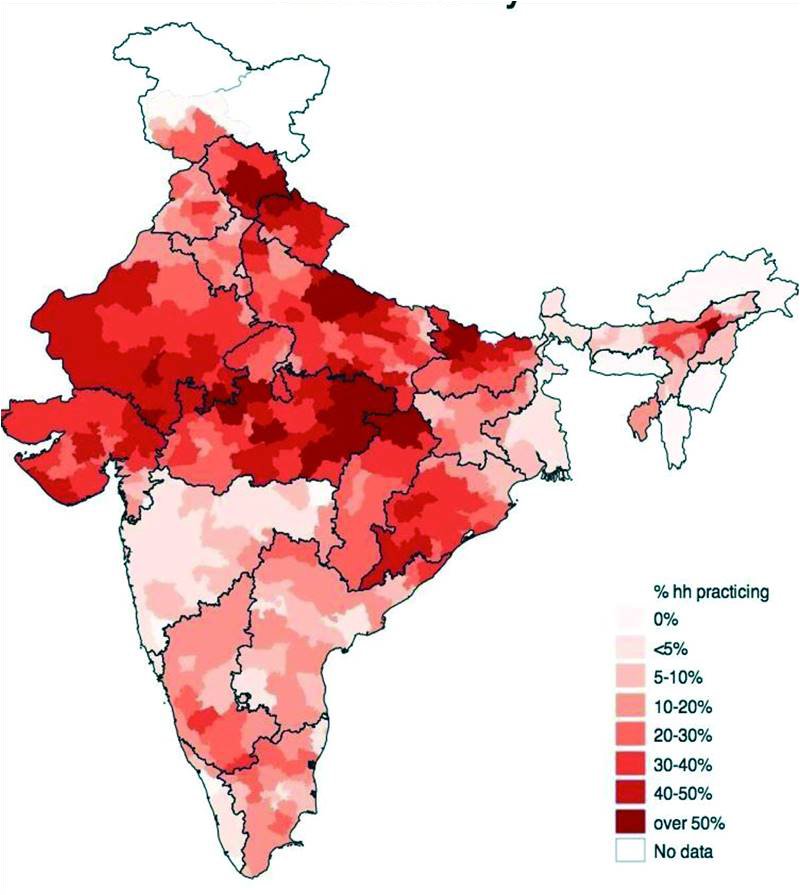
The long lease of life for caste is also due to the defeatist mindset of lower strata that accepted their humiliation as a fait accompli and never rebelled. Dr. B. R. Ambedkar has quoted many instances from his early life when he suffered indignities due to his low caste. He mentions that in school, only one peon was allowed to pour water on his hands to drink and when that peon was absent, he went thirsty. He writes that untouchable children were segregated and not allowed to sit in the class.
Ambedkar wrote two masterpieces on the caste system. One was “Caste in India”, a speech that he was not allowed to deliver. And the other was a work titled Annihilation of Caste in which he boldly advised the Hindu leadership,
“You must have courage to tell the Hindus that what is wrong with them is their religion.”
Ambedkar, however, never rallied Dalits to throw off the yoke of untouchability by force – even though he himself converted to Buddhism to escape dehumanizing caste system.



Nice article. Segregation is sign of hatred and against human dignity.
How do you see the segregation of man and woman in Islam?