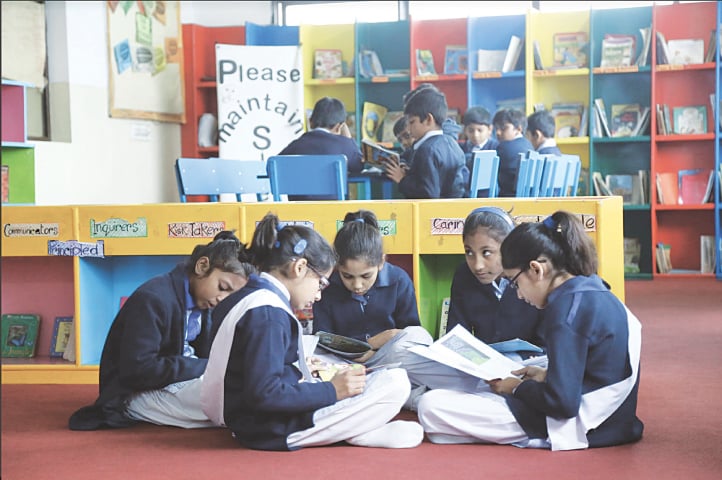
The Single National Curriculum (SNC) is an outcome of the promise of Naya Pakistan. A Pakistan free of educational apartheid, where education is aligned to the emerging international trends in teaching, learning and assessments, which develops analytical skills, critical thinking and creativity in students, and which moves away from rote memorisation. A Pakistan where it doesn’t matter whether one attended an ‘elite’ private school, a public school or a madressah. A Pakistan where every schoolchild will receive the same kind of education, and will thus have the same opportunities in life.
The promise is like a dream come true. But like many well-intentioned plans, the recently-announced review of education policy seems better as an abstract idea. A closer review of the published material throws up many issues of concern. The new SNC has been approved and announced for grades I to V so far, and flaws in the policy are already becoming apparent.
For one, the SNC confirms to us that education policymakers continue to have a skewed belief in what constitutes quality education. They believe that, even if English language is completely alien to a five-year-old child, he must nevertheless be instructed in English. They also believe — contrary to all available evidence — that a greater dose of religious education will produce more honest and useful citizens of Pakistan. Critical thinking is central to modern knowledge, while through the SNC, policy planners seem to be promoting influences that are antithetical to critical thinking. The primary focus is on the sheer quantity of information poured into students’ heads.
The government’s slogan of reform is: an end to educational apartheid, a laudable goal indeed. But what has been approved and notified is a uniform curriculum, not a system of uniform education. The latter would also imply equal educational facilities for all — rich and poor, rural and urban, boys and girls. Only a uniform education would ensure an end to the educational apartheid. But the government has not put forward any plan for uniform education yet. And it is unclear if it ever will.
WHAT’S BEHIND THE UNFULFILLED PROMISES?
The Pakistan Tehreek-i-Insaf (PTI) government started its tenure with an Education Policy Framework, highlighting reforms in four priority areas in education. These were: (1) Putting all the out-of-school children in schools, as required by Article 25 A-of the Constitution; (2) eliminating apartheid in education by introducing a uniform curriculum; (3) enhancing the quality of education; and (4) emphasising technical and vocational education.
The Framework was generally regarded as based on a correct diagnosis of the problems of school education in the country. If pursued properly and thoughtfully, reforms made within this framework could potentially add quality to public education.
In the two years since the Framework was announced, the government has made some progress in the second priority area by preparing a SNC, but has made no move in the other three priority areas. I suspect this is because each of the other three priority areas would require a heavy financial commitment, which the meagre national allocation to education could not promise. On the other hand, introducing a new curriculum comes for free.
The government’s slogan of reform is: an end to educational apartheid, a laudable goal indeed. But what has been approved and notified is a uniform curriculum, not a system of uniform education. The latter would also imply equal educational facilities for all — rich and poor, rural and urban, boys and girls.
Take priority number one. With 22.8 million out of school children, according to Unicef data, and the total number of enrolled school students around 25 million, there are nearly as many out of school children as there are in school.
To put nearly 23 million additional children into school would be a gigantic task. Pakistan would need to build nearly as many schools as exist today, furnish them and employ as many new teachers as are currently in service. Imagine the amount of resources needed to provide schooling to all 23 million out of school children. How difficult this will be is illustrated by the example below.
The Islamabad Capital Territory (ICT) lies right under the nose of the federal government and is hardly some rural district of Balochistan or Sindh, and yet there is a 35 percent deficit of teachers in ICT public schools. The posts are not being filled because the government has no money to pay the additional salaries. Some federal government model schools are running at two-thirds of the approved strength of teachers. Teachers are either forced to conduct multi-grade teaching or to ask a senior student to stand in the class with a cane in hand, to keep the children quiet.
Let us consider the third priority area: the enhancement of quality of education in school.
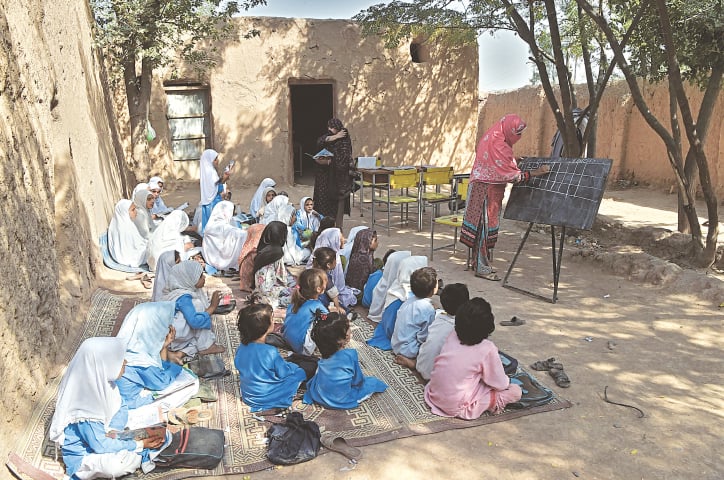
That the quality of learning in public and private, urban and rural, schools is extremely worrisome has been regularly highlighted by Annual Status of Education Report (ASER) surveys for over a decade. These are considered reliable to the point that even the Ministry of Federal Education and Professional Training (MOFEPT) refers to their data rather than that from the official National Educational Management Information System.
If the government is really serious about the quality of education, it must not pass the burden of providing education to the private sector. A large part of the private education sector consists of low fee schools. Their business model works with low fees only because they employ uncertified teachers at very low salaries. Hence the quality of instruction in those schools remains abysmally poor. The government knows this very well, because it supports such schools through national and provincial Education Foundations, and pays them a meagre subsidy of 300 rupees per student to encourage them to continue.
Enhancing the quality of instruction in public schools would require several things.
One, it would require more frequent and better pre-service and in-service training for the teachers. Provincial staff development departments would vouch that, presently, a public sector teacher receives only about three days of in-service training per year. What is needed is perhaps 10 times more training.
Two, public schools still lack in essential facilities such as furniture, water supply, toilets, etc. The situation continues to be so in spite of receiving donations for the infrastructural improvement of schools from several countries. A rigorous auditing of where these funds go is badly needed.
Three, textbooks provided by the state are of abysmal quality, both in content as well as in presentation. Pakistani textbook boards have repeatedly proved unable to provide good-quality learning material. A comparison between the books used in public schools with those used in the elite private schools easily shows the differential in quality. A heavy investment in high-quality textbooks is an essential requirement for improving educational quality. There is no reason to restrict the choice to local authors and printers. For the sake of investment in our national future, we should keep open the option of buying the best teaching material, even if local cultural sensitivities call for some editing.
And four, public examinations of today only require reproduction of text. Unless the assessment system is radically altered, the quality of education in the public schooling system cannot improve. Those who set high-quality examinations do not come cheap.
From the above, it is obvious that improving the quality of education cannot be achieved without a heavy financial input.
Finally, the last priority area of the Educational Framework — introducing technical and vocational training in schools — would also require substantial expenditure on equipping schools with functioning workshops and an assured supply of consumables.
Thus, meaningful action in priority areas numbers 1, 3 and 4 obviously call for substantial financial input. Instead, the government has taken the easy road by simply tinkering with the curriculum. This not only vitiates the very idea of reform, it also creates other deep problems.
Let us now come to the SNC.
CONSTITUTIONAL TRANSGRESSION
In the current design of SNC, the federal government has transgressed upon the constitutional domain of the provinces. The Parliament, through the 18th constitutional amendment, had transferred the curriculum-making authority to provinces, restricting the federal government’s domain to the federal capital area and the educational institutions directly under its control. This did not go down well with those who (wrongly) regard provincial autonomy a danger to national cohesion. It also did not go down well with those who regard school education less as an exercise in enabling future generations to face global challenges, and more as a means to influence young minds ideologically.
To put nearly 23 million additional children into school would be a gigantic task. Pakistan would need to build nearly as many schools as exist today, furnish them and employ as many new teachers as are currently in service. Imagine the amount of resources needed to provide schooling to all the 23 million out-of-school children.
A grievous yet inevitable consequence of this effective re-centralisation of the curriculum is immediately apparent in the social studies curriculum. In a decentralised curriculum, a child is taken gradually from an awareness of self, to family, to neighbourhood, then to awareness about his or her district, about the province, then nation and then the world. In this re-centralised curriculum, in contrast, however, the child is taken from the awareness of self, to family, to the neighbourhood and then straight to the nation. A child under this leapfrog curriculum will never get to learn about his or her district or province, which will be a serious loss to the child’s worldview. The leapfrog seems to be a deliberate policy of those whose narrow view of nationalism insists on denying identities of constituent nationalities.
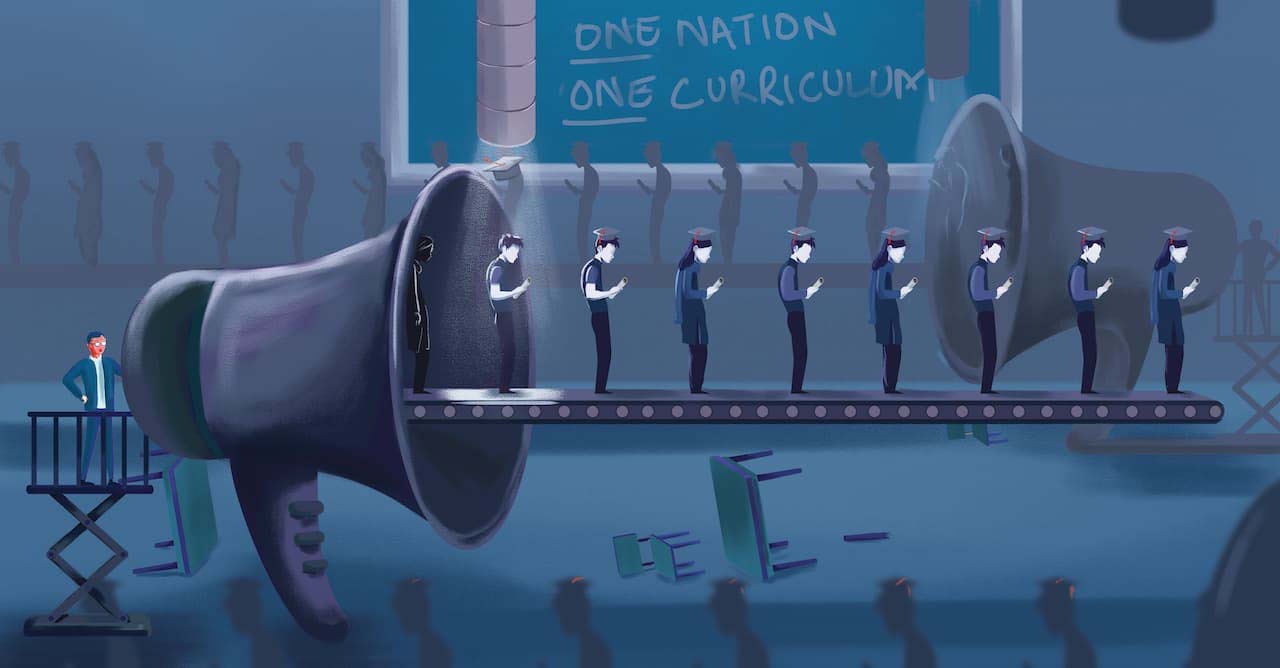
The new curriculum documents carry a slogan of “One Nation One Curriculum”, implying that, without a single curriculum, we cannot remain one nation. This is false. There are countless examples of countries having diverse curricula — even ones that vary from school to school — and yet a strong sense of common nationhood. Advocates of uniformity may like to keep in mind a well-known saying: uniformity has the colour of deserts while the beauty of gardens is in their diversity. While rifts and dissension do exist within Pakistan, their causes lie well outside the school curriculum. Oversimplification may create further chasms between the different peoples of Pakistan instead of moving us towards greater unity.
THE EDUCATIONAL APARTHEID
The educational apartheid is said to be the reason behind the need for a uniform curriculum. As is well known, the Pakistani education system is split along three broad lines: a tiny sliver of expensive private schools preparing students for foreign examinations; low-to-middle end public/private schools that follow the federal/provincial curriculum; and madressah education, that aims to produce the clergy.
The prime minister has been very passionately arguing against this apartheid, pointing out differentials in the competencies developed in each and hence the corresponding opportunities that open up before students graduating from each of the three systems. He emphasises that the students from elite schools have the best opportunities and graduates of madressahs have relatively much fewer.
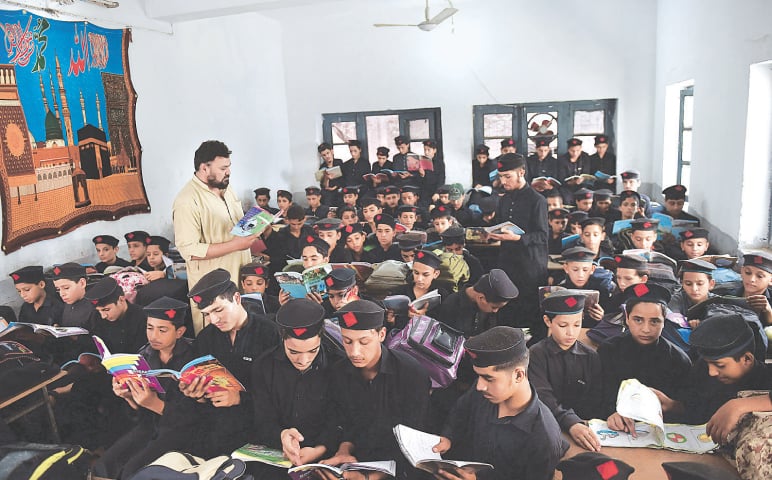
This is a valid point. Mainstreaming of madressahs has been a desire of many a government in the past, and even of religious groups and political parties. In the 1980s and 1990s, the Institute of Policy Studies, Islamabad, a think tank of the Jamaat-i-Islami, held conferences of all the madressah systems to explore if, besides the theological subjects, they would open themselves to teaching of contemporary disciplines. One stubborn response was that the reason of existence of madressahs was to not let the Islamic theological disciplines, which debate intricacies of belief and practices, be forgotten, and that madressahs exist to produce clergy to keep the knowledge of Islam alive.
But in the post-9/11 environment, when all eyes were focused on them, most madressahs were persuaded by the Musharraf government to introduce contemporary subjects such as English, Mathematics, Science, Social Studies, Computer Literacy, etc in their list of courses. So, while Prime Minister Imran Khan is right that the graduates of madressahs remain on the lowest rung of job opportunities, he seems unaware of the fact that most madressahs had already included contemporary subjects in their curricula. This can be checked from the websites of all the madressahs’ wafaqs (boards).
According to the MOFEPT website, the understanding with madressahs envisages that “madaris [madressahs] will gradually introduce contemporary subjects in deeni madaris [religious seminaries] under a formal plan, up to Matric and Intermediate in the next five years.”
The public school system is the other component of the educational apartheid system. Although the public school curriculum, which is followed by all the public schools as well as a number of private schools, gets reviewed every few years, it does not seem to have any significant effect on the quality of learning. Year after year, surveys on students’ competencies bring out the terribly worrying levels of abilities in students. For example, the 2019 national survey of public and low-fee private schools by ASER shows that 15 percent of grade V students still cannot read Urdu sentences, 11 percent cannot read English sentences and eight percent cannot do simple two-digit subtractions. These are all recorded in the annual ASER reports. Universities lament the poor quality of their new admissions, and employers are unhappy about the quality of graduates they receive from universities.
There is, thus, a genuine concern about the quality of education and to put the finger on the right causes is the foremost challenge for Pakistani education policy planners.
THE EXPECTATION
Given these problems and the desire of the government to evolve a system that provides a level playing field for the graduates of different kinds of educational institutions, there were expectations that this levelling exercise would be coupled with quality enhancement schemes. That is the only way to create a level playing field.
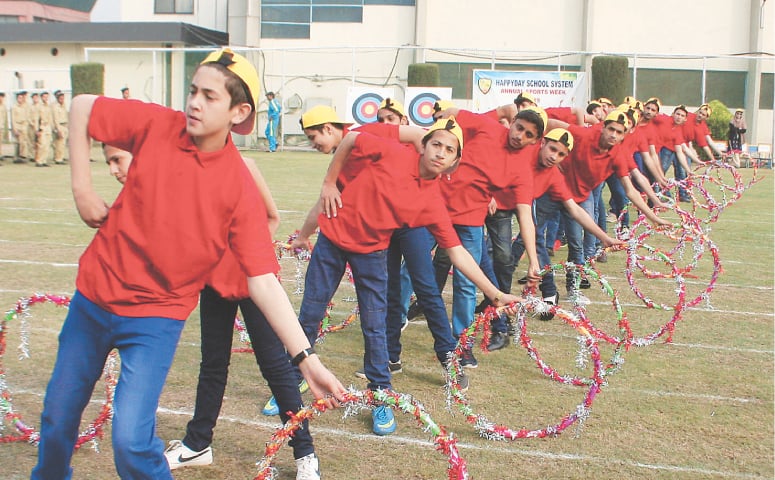
For such an objective, the choice should have been the best available standard in the country. As the prime minister himself admits, the best quality comes out of the English-medium private schools, which follow some foreign educational schemes, either the British O and A levels or the International Baccalaureate. It was expected that the new curriculum would be modelled after these schools.
But this was not to be. Instead, the government chose the public school curriculum devised in 2006.
The benchmarks, the learning outcomes and the identification of competencies for each level remain roughly the same as in the 2006 curriculum. There is, therefore, no reason for optimism because the quality of learning with this curriculum would be just as unsatisfactory as in today’s public schools. With the same course content as before, the standard of textbooks and classroom teaching is likely to remain the same.
In short, the best of the three standards has not been adopted. In addition, there is no indication at all of any serious effort to move the examination system away from rote learning. All of this means that, if the new curriculum is imposed on the elite private schools, their educational standard will face a substantial degradation.
THE NEW ISLAMIAT CURRICULUM
The courses on English, Urdu, Arithmetic, Science and Social Studies are hardly distinguishable from those prescribed in the 2006 National Curriculum — they have the same benchmarks and the same learning outcomes as before. But one area where major changes have been introduced is in the Islamiat curriculum.

The National Curriculum 2006 for grades I and II had topics of Islamiat included in a course named General Knowledge, and was consequently a source of deep discomfort among non-Muslim children, since they were forced to learn Islamiat. The SNC has taken these topics out from General Knowledge and made a separate full course on Islamiat.
As per the declared curricula for grades I to V, the new course on Islamiat is far heavier in content than any previous Pakistani school curriculum for this subject. When compared against Islamiat taught in madressahs at this level, it turns out that public and private schools will be teaching more religion than even the madressahs.
From the published SNC document, that also details the structure of topics that will be followed up to grade XII, the Islamiat course for all the grades from I to XII will be structured around the following seven topics:
-
Holy Quran and Hadith
-
Faith and supplications
-
The life of Prophet Muhammad (PBUH)
-
Islamic mannerism
-
Public dealings and social behaviour
-
Islamic personalities and guiding lights
-
Islamic teachings and contemporary issues
As an example, the Islamiat course for grade III in SNC has the following detail:
SNC Islamiat Curriculum for Grade III
For grade III, the SNC prescribes the following topics:
• Nazra Quran from paarah three to eight
• Memorisation: Surahs Fateha, Kausar, Nasr, Ikhlaas
• Memorisation with translation: Allahu Akbar, Astaghfirallah, Jazakallaho Khaira, Durood-i-Ibrahimi
• Memorise: eight prescribed ahadith
• Memorise: prayers to start a meal and to end a meal
• Introduce Tawheed, translate Kalma-i-Tayyaba and Surah Ikhlas
• Learn about nabuwwat and risalat
• Memorise Kalma-i-Shahadat with translation
• Learn about azaan, namaz and wuzu, and qibla and masjid
• Topics from the life of the Holy Prophet (PBUH)
• Ikhlaq-o-Adaab from the Quran and Sunnah
• Huquq-ul-Ibad from the Quran and Sunnah
• Lessons on Hazrat Adam (AS), Hazrat Nooh (AS) and Hazrat Abu Bakr Siddiq (RA)
• Lessons on health from the Quran and Sunnah
It is instructive to compare the above with the madressah curriculum for the same grade. The information in this case has been taken from the websites of various madressah boards. Only two of them, Tanzeem-ul-Madaris of Jamaat Ahle Sunnat and Rabitatul Madaris of Jamaat-i-Islami provide the curriculum for primary classes.
Tanzeem-ul-Madaris Islamiat Curriculum for Grade III
-
Nazra of the first five paarahs of the Quran
-
Practical training of wuzu and namaz
Rabitatul Madaris Islamiat Curriculum for Grade III
-
Nazra of the first five paarahs of the Quran
-
Training for namaz according to Sunnah
-
Towheed wa Risalat
-
Aakhirat
-
Islamic governance
It is clear that the Islamiat curriculum in SNC is much heavier than in madressahs. It requires a large amount of memorisation in Arabic and, in places, in Urdu translation as well. It requires memorisation of ahadith in Arabic and in Urdu. The two madressah boards’ curricula do not require memorisation, or even reading, of ahadith. Memorisation of Hadith was not a part of even the 2006 curriculum. The 2006 Curriculum required learning ahadith only in grades IX and X, and only in Urdu. In the SNC, on the other hand, primary grade students are required to memorise Arabic and Urdu versions of 45 ahadith by grade V, with the following grade-wise distribution: 4 + 6 + 8 + 12 + 15. It can only lead us to conclude that the framers of the SNC have been overly zealous in prescribing Islamiat content.
If the teaching of Islamiat is so extensive at the primary level, where young children are still struggling with elementary literacy, one is left wondering how much more extensive it will get at the higher levels. Punjab has already issued an ordinance to teach Quranic studies at the highest levels of studies in universities. How will those studies be different from madressah curricula? It is not beyond the pale of possibility that the higher level Islamiat courses will be inspired by madressah curricula. In this sense, SNC looks like a ‘madressah-isation’ of schools.
After Nazra Quran, the next step in madressahs is learning the Quran with translation, and then, at a higher level, looking deeper into interpretations of the Holy Book, the tafseer, the taabeer and then fiqh. It is well known that sects in Islam have grown out of such interpretations by the most learned scholars. We also know that different sects of Islam are followers of different interpretations. Different schools follow different makatib-e-fikr or schools of thought, and their differences have persisted over the centuries. When elevated to the level of colleges and universities, will the study of Islamiat not touch upon these divisive issues and lead to sectarian tensions on campuses?
THE PROBLEM OF ARTICLE 22(1)