최종 업데이트: 2026년 4월 6일 | 5년+ 검증 경험 | 1,500+ 검증된 사이트 | 10만+ 사용자 신뢰
토토사이트 2026 - 검증된 안전한 베팅 플랫폼 완전 가이드
토토사이트를 찾고 계신가요? 2026년 현재, 온라인 베팅 시장은 급속히 성장하고 있으며, 수많은 토토사이트가 존재합니다. 그러나 그 중에서도 안전하고 검증된 사이트를 선택하는 것은 매우 중요합니다. 사기사이트, 먹튀사이트, 출금 지연等问题으로 인해 많은 이용자들이 피해를 보는 것이 현실입니다.
본 가이드는 2026년 최신 토토사이트 정보를 바탕으로, 검증된 안전한 메이저사이트를 엄선하여 소개하고, 사이트 선택 시 반드시 확인해야 할 보안 요소, 보너스 활용법, 입출금 과정 등을 상세히 설명드립니다.
Dr. Abdus Salam and All the Wrong Choices Pakistan Made
Nayyar Afaq
What does it take to be a genius?
The other day this thought struck me. Is it the environment that nurtures the genius or does nature simply endow certain individuals with a special gene? Maybe both propositions have merits of their own, but for the time being, let’s drop the latter. Let’s suppose there are no chosen ones, there are no saviours.
The idea of saviours arises when we start to believe in pseudo-science and seek miracles to solve our problems. But mind it, Aladdin’s lamp or magic wands don’t exist in the practical world. The only magic that works is the labour of hands at the end of one’s own arms and the thinking brain in one’s own head.
The third-world countries need the same magic for their socio-economic development; self-reliance, hard work and stimulating intellectual environment. Mix these ingredients and a successful society will develop. Pakistan, I regret, still misses these elements, and hence, is still far from being developed.
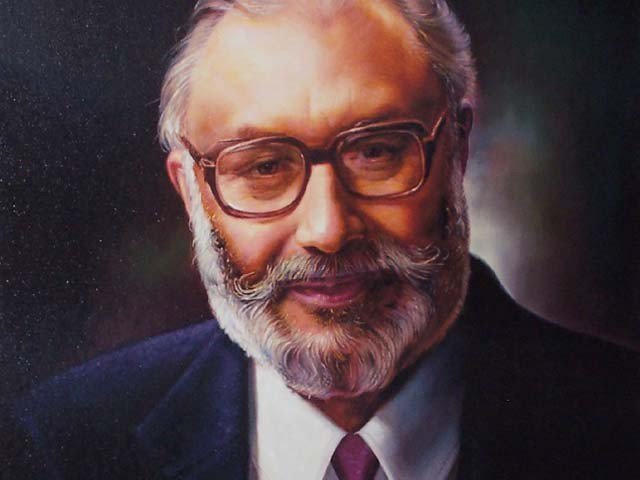
Today, at the 90th birthday of the first noble laureate of Pakistan, Dr Abdus Salam, it would be wise to take a look at his life and to introspect what wrong choices we made.
Salam was a genius for the world, nonetheless a discarded one in his own country. Born in a village near Jhang on January 29, 1926, he studied in an ordinary Urdu medium school that lacked furniture. He belonged to a lower-middle class family. His house had no electricity, or any other basic facilities. His circumstances were challenging, yet they never served as an excuse.
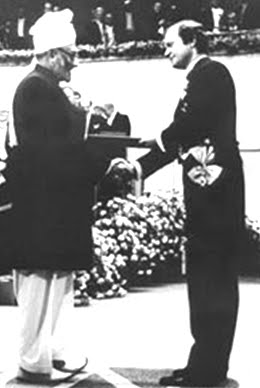
The fact that he scored the highest marks ever recorded for the matriculation examination at the age of 14 and published his first research paper at the age of 17 indicated his gifted potential. But who, at that time, could have imagined that this young prodigy would have received the most prestigious Nobel Prize in Physics for his contribution to the unification theory.
Dr. Abdus Salam recieves the Nobel Prize for Physics from King Carl XVI Gustav of Sweden on December 10, 1979.
Not only was his unification theory a touchstone of modern physics, he also laid the pioneering work for the discovery of Higgs boson (referred to as the God-particle) in 2012 which happens to be the most important discovery in Physics in the last four decades. This discovery took place at the Large Hadron Collider established at CERN, a European organisation for nuclear research.
Last year on July 31st, Pakistan became the first non-European country to become an associate member of CERN. In his recent visit to CERN, Prime Minister Nawaz Sharif hailed the contribution of Pakistani scientists, and also paid tribute to Salam calling him the pride of the country.
This statement, however, couldn’t wash out the stain of guilt that the subsequent governments of Pakistan and the entire nation still carry. While the entire world applauded him, Salam was never regarded as a hero in his own country. He’s considered the opposite – a traitor.
What we did to Salam is shameful to say the least. When he returned to Pakistan after receiving the Nobel Prize, no one received him at the airport. Right wing propaganda concocted conspiracy theories to accuse him of nuclear espionage. When he was invited to Quaid-e-Azam University for his lecture, he was threatened by the fundamentalist students. Ziaul Haq refused to endorse the candidature of Salam as a Director General of UNESCO even though Salam visited nearly 30 countries in 1987 and gained their support. In 1988, the then Prime Minister, Benazir Bhutto, refused to meet him after making him wait for two days in a hotel. Similarly, Nawaz Sharif, in his first term of premiership, conveniently ignored Salam while mentioning the distinguished alumni of Government College, Lahore while addressing its convocation. Had Salam given up his Pakistani nationality, he would have easily avoided such humiliations, but he remained a Pakistani national until his last breath.
Salam’s biggest failure was not some personal tragedy – a person of his stature with generosity of spirit could forgive personal sufferings. His agony was due to a far bigger tragedy. Salam dreamt of establishing an international research centre in Pakistan for third-world physicists. He wanted to stop the brain-drain, but no government showed interest. He ended up setting up the International Centre for Theoretical Physics in Trieste, Italy that was later renamed the Abdus Salam International Centre for Theoretical Physics.
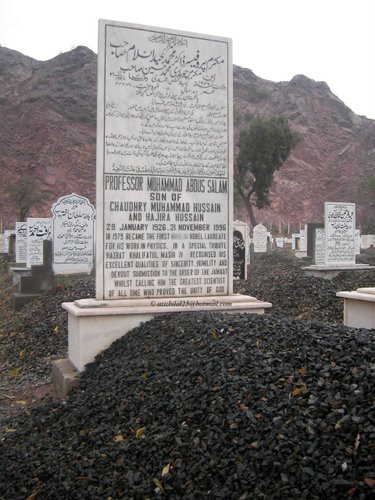
All of this took a toll on him, and in last years of his life, he became the victim of a neurological disorder and was confined to a wheelchair. He died in Oxford, England on November 21, 1996. He was buried in Pakistan on his request. No government official attended his funeral. His misery didn’t end with his death. The epitaph of his tombstone was defaced as a final disgrace to remove the word ‘Muslim’from it.
Defaced tombstone on Dr. Abdus Salam’s grave. Photo: Aziz Bilal
If we look back in history, the Mongols invaded Baghdad and demolished Baitul Hikmah, a centre of excellence during the Islamic Golden Age. Ibn-e-Rushd was exiled and his books were burnt. When Europe found the light to get out of the Dark Ages, the Muslim world lost its way. And now the country where Salam was banned from delivering his lectures in universities is witnessing terrorism in those very educational institutes.
I again seek your attention towards the dilemma that I mentioned in the start: What does it take to be a genius in any society?
There are no chosen ones, there are no saviours.
For socio-economic development, self-reliance, hard work and a stimulating intellectual environment is required. Where there is no such environment, there are no scholars, there are no intellectuals and there are no heroes. Even if someone, like Salam, somehow manages to prove his talent, he would not be treated as a hero. He would be shunned.
Today is the 90th birthday of Dr Abdus Salam. The best way to wish him is to let freedom of religion and intellectual thought prevail in the country.