최종 업데이트: 2026년 4월 6일 | 5년+ 검증 경험 | 1,500+ 검증된 사이트 | 10만+ 사용자 신뢰
토토사이트 2026 - 검증된 안전한 베팅 플랫폼 완전 가이드
토토사이트를 찾고 계신가요? 2026년 현재, 온라인 베팅 시장은 급속히 성장하고 있으며, 수많은 토토사이트가 존재합니다. 그러나 그 중에서도 안전하고 검증된 사이트를 선택하는 것은 매우 중요합니다. 사기사이트, 먹튀사이트, 출금 지연等问题으로 인해 많은 이용자들이 피해를 보는 것이 현실입니다.
본 가이드는 2026년 최신 토토사이트 정보를 바탕으로, 검증된 안전한 메이저사이트를 엄선하여 소개하고, 사이트 선택 시 반드시 확인해야 할 보안 요소, 보너스 활용법, 입출금 과정 등을 상세히 설명드립니다.
Kasauti: Foundations of Natural and Artificial Intelligence
Vaqar Khamisani
Disclaimer:The Eqbal Ahmad Centre for Public Education (EACPE) encourages critical and independent thinking and believes in a free expression of one’s opinion. However, the views expressed in contributed articles are solely those of their respective authors and do not necessarily reflect the position or policy of the EACPE.
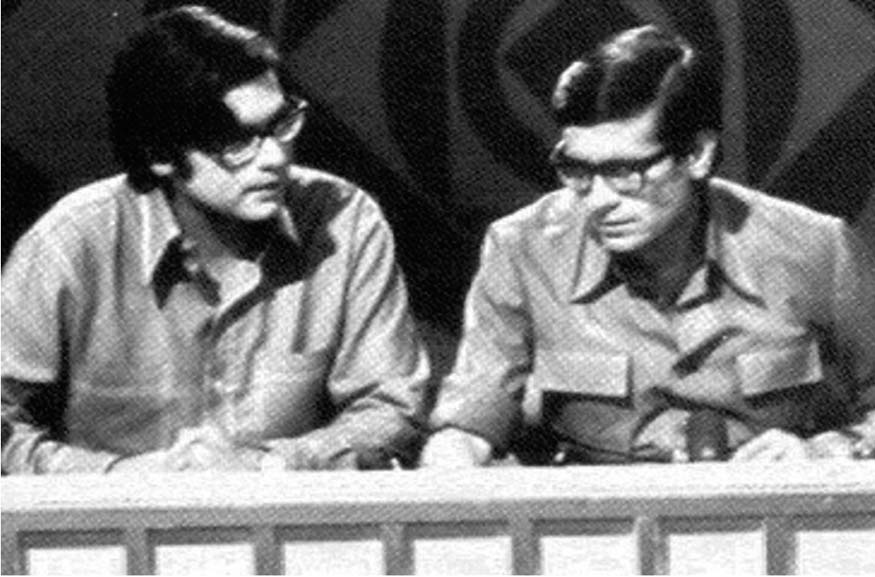
Growing up in Pakistan during the mid-seventies, a TV show captured the imagination of millions of young and old alike. The program was an instance of a popular American show from the forties named the Twenty Questions. The localized version was called Kasauti which literally means ‘touchstone’, however, keeping in mind the context of the program, it could also be translated as ‘test’. Kasauti was hosted by a learned person called Quresh Pur, and it had two brainy experts, namely Obaidullah Baig and Iftikhar Arif. The visitors to the show came prepared with a specific personality they wanted the experts to guess in 20 questions which received twofold (yes/no) responses from them. Although other categories were permitted, the guests generally had a personality in mind during most of the shows.
Both the masterminds were vastly knowledgeable on a variety of subject-matter and their intellectual depth visibly came across during the proceedings of the show. As they went about making correct guesses most of the times, the whole country marvelled at these gurus who became instant celebrities. My immediate family members were mesmerized by the show and we began playing our own in-house version of Kasauti, where one of us would think of a personality whilst others would ask questions. This practise of playing Kasauti continues to this day in my family!
Fast forward a decade or so later to one of my undergraduate classes at the University of Michigan. The professor posed a seemingly simple question to the class. He had in mind a number from 1 to 30 and wanted to know the minimum questions needed to deduce the right answer. A simplistic approach at solving this would be to orderly guess one number at a time leading to the correct answer. This method would require asking 30 questions in the worst-case scenario, although if we are lucky we could achieve it in less time.
Knowledge and Search constitute two of the most important pillars of contemporary AI programs that are researched, developed, and deployed.
The professor explained that one needs to ask only 5 questions to guess the right number by using an approach called binary search. Essentially, the methodology requires one to split the range of numbers in roughly two halves and simply inquire which half the target number belongs to. Based on the response, one could then follow the same strategy on the half where that number is located. For example, the first question to ask would be if the number is within [16-30] range, this is because we want to divide the total range of [1-30] into two buckets. Now, in case if the response is in the affirmative, we would make a note of the approximate mid-point of [16-30] range, which could be 23. Next, the second question to ask is if the number belonged within the [23-30] range, and then based on the answer follow the same divide-and-conquer logic. The readers are encouraged to think of a number and work out to see for themselves that five questions are all what it takes to guess the right number!
Binary search is not only an efficient algorithm, but it is also super-scalable. As we expand the range of numbers to pick from, the amount of questions that are required to ask do not grow at the same rate. So, as the professor explained, identifying an arbitrary number from a range of thirty requires 5 questions, however, if we were to choose from a range of thousand numbers, it will need only 10 questions to make the right guess, whereas, correctly calling out a random number picked up from a range of a million amazingly requires merely 20 questions!
As it turns out that the application of binary search is much more than playing number-guessing games. In fact, a variant of it was inadvertently and naturally in play by the experts during Kasauti as they went about asking questions to narrow down potential personalities. The key is to ask questions that bifurcate the range of possibilities in approximately two halves, and then, carry on with next questions that do likewise until we arrive at definitive conclusions. For example, one of the first questions asked by the experts was regarding gender, which divides the range of possibilities into two big buckets. The next questions such as being alive, era, and region all helped narrow down the possibilities in roughly two big chunks each time.
Now, recall that identifying any number selected from a range of a million requires asking 20 questions. Therefore, even if we were to grossly overestimate by assuming that the two experts had a million personalities in their mental repositories at the onset, asking 20 questions that partition in a binary-search like manner were enough to lead them to the right answer!
Knowledge and Search constitute two of the most important pillars of contemporary AI programs that are researched, developed, and deployed.
Hence, the two essential ingredients that enabled the experts to display their specialized skills during Kasauti were their large knowledge base as well as efficient searching. Having knowledge alone is insufficient as poor searching will make it impossible to arrive at the right answer within 20 questions. Likewise, solely applying effective search will not yield the desired outcome if they did not possess knowledge of the requisite personality.
The importance of knowledge and search to achieve intelligence was championed by researchers including one of the founding fathers of AI, Alan Newell, who was a renowned cognitive psychologist as well as a recipient of the highest award in computer science called the Turing Award. Their conclusions were derived from the evaluation of several transcripts of verbal protocols which involved experts thinking out aloud whilst solving different types of problems. To this day, knowledge and search constitute two of the most important pillars of contemporary AI programs that are researched, developed, and deployed.
Gaining an understanding of how masterminds go about solving puzzles does not in any way undermine them. The experts in Kasauti were innately merging their vast knowledge with efficient search to arrive at the right answers. Their approach was in no way different from other experts that play chess, bridge, or are otherwise involved in intelligent activities. By coupling wisdom with their humble, gentle, and down to earth mannerism, the Kasauti intellectuals have inspired more than a generation of fans to emulate their brilliance.




 Vaqar Khamisani is based in London and works as a Global Director of Insights for a leading information-based analytics company.