
Science matters. Many yearn for science-free times when wars were fought with swords by valiant Ertugrul-like horsemen. Quite a few want still earlier riyasats. But I have yet to meet a fellow Pakistani willing to have a bad tooth pulled out without anaesthesia or who sends emissaries instead of using a cellphone.
These days, electricity and gas loadshedding have triggered a collective nervous breakdown, while the price of petrol is all that people talk about. All of this would be utterly incomprehensible to those who lived a mere hundred years ago. Ancient civilisations had nothing even remotely similar to the science that exists today.
Like it or not, all modern science — that which is rapidly changing our world on a day-to-day basis — is the 400-year-old child of European modernity. Although many civilisations — Egyptian, Babylonian, Chinese, Indian, Greek and Arabian (chronologically ordered) — helped create that science, not enough was known earlier to create an overarching picture of a universe run by physical law. Nor did earlier civilisations use science to create functional technologies like we do today. Instead, significant advances in ancient science came from men of genius following scholarly interests rather than economic ends.
But now that civilisation on earth has become science-based, the pursuit of science is systematic and relentless. Every country is rushing to acquire mastery over it and, even more, to use it to create technologies to fulfil social desires. Although science and technology (S&T) are two different worlds, the boundary between them has blurred with time. For example, learning how cells divide was considered pure science in the 1800s. Today, it is crucial to discovering cures for cancer.
There is little appreciation in Pakistan for the centrality of science in every modern economic pursuit. Pervez Hoodbhoy deplores the degradation of our scientific capabilities and wonders whether we can change our worldview.
An attempt to situate Pakistan’s S&T may be made using two different lenses; to compare today’s situation with what existed in 1947 (and even earlier); and to draw parallels between Pakistan and other countries in the region. As a starting point, I will take the advent of modern education in India (as opposed to traditional education) because that is where the bifurcation between modern and conventional ways of life began.
Pre-partition situation
India during the Mughal rule saw spectacular achievements in architecture, art and administrative matters. But there was little curiosity in matters of the intellect, particularly science and philosophy. As a result, no university was built in those three centuries of otherwise brilliant rule. Although internal feuds and succession issues were doubtless a significant cause of decline, this lack of interest in intellectual pursuits eventually led to 40-50,000 Englishmen, armed with technology and the scientific method, overpowering and crushing what had been a magnificent empire. Few understood the secret source of English power better than Mirza Ghalib. Differing from those who craved a return to past glories or who suggested picking up arms against the firangis, his thinking was quintessentially modern:

Go, look at the sahibs of England; Go learn from them their skills and ways; From their hands have sprung wonders and wonders; Go try and see if you can excel them.
Science education in British India was spread by three principal agents: British government, Christian missionaries, and education reformers from both Hindu and Muslim communities. Whereas the Hindus had many well-known reformers, among the Muslims the only well-known one was Sir Syed Ahmad Khan. His vigorous advocacy of science and modernity as a means of uplifting Indian Muslims differed sharply from those who feared learning English and science would diminish their religious faith. He had disagreed with Ghalib earlier, but, upon reflection, he became convinced that India’s Muslims must abandon conservatism and travel new paths.
Sir Syed’s heroic efforts notwithstanding, Muslim enrolment in schools remained low. The University of Calcutta was the first secular Western-style university in India, and set standards as far away as Punjab. The requirements being rigorous by the standards of the time, only a few Muslims applied or qualified for admission. Although the populations in Bengal were proportional in size, hundreds of Hindus but just two Muslims passed the first BA examination in 1858.
Early years
Let us fast-forward to 1947. Of the 16 universities in British India, Pakistan inherited only one teaching university, i.e. the Punjab University in Lahore. Additionally, there were some 25-30 colleges in the areas that are now Pakistan. Most were in Punjab; Balochistan had none. Because Muslims had entered academia late and in fewer numbers, the senior faculty in almost all institutions of higher learning was predominantly Hindu at the time of partition. Once rioting began, they fled to India and Muslims from lower ranks filled their positions. Academic quality plummeted.
With time, education numbers slowly increased. By 1969 there were a total of eight universities in united Pakistan. The breakup and subsequent emergence of Bangladesh in 1971 temporarily froze further development. However, the quick post-partition promotions of junior faculty had profoundly debilitating consequences in terms of teaching quality. Mediocres rose to become department heads, deans, and vice-chancellors. They blocked bright young entrants lest their authority was challenged. As a result, rote learning became almost as common in universities and colleges as in schools and seminaries.
Nevertheless, in Pakistan’s early years, there were pockets of excellence in some S&T fields. I will mention only four.
Pakistan’s space programme began in 1961 with the launch of meteorological rockets provided by the United States. Initiated and headed by Professor Abdus Salam, the Space & Upper Atmosphere Research Commission (Suparco) grew rapidly in the 1960s and was more advanced than the Indian programme at the time.

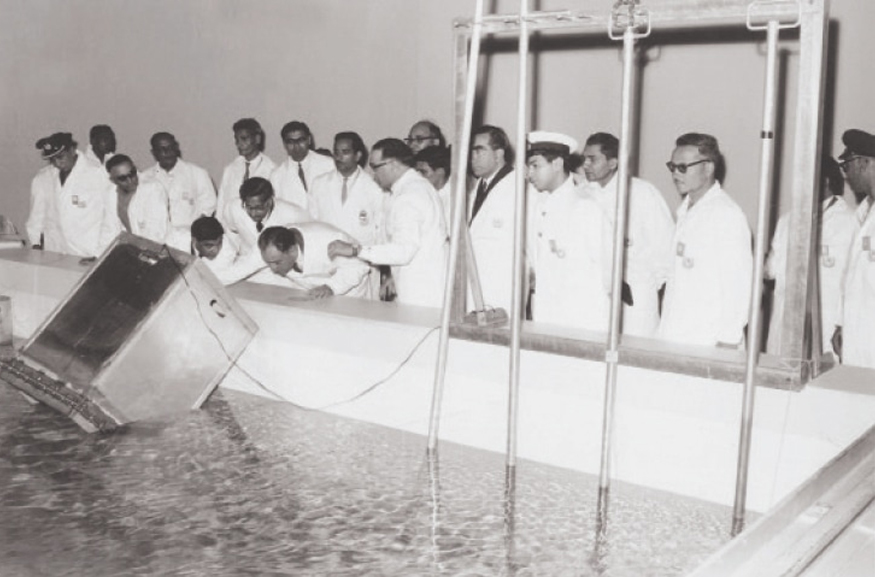
Pakistan’s nuclear programme was set in place with the assistance of the US and, until 1972, had been directed towards nuclear power production and basic research. Personnel in the Pakistan Atomic Energy Commission (PAEC) were sent abroad in the 1960s for training. Canada provided Pakistan’s first nuclear reactor, the Karachi nuclear power plant (Kanupp). The returnees successfully maintained and operated the reactor even after the withdrawal of Canadian fuel and technical support. India’s 1974 nuclear test led to Pakistan’s open desire to match the Indian bomb, causing the reversal of the West’s nuclear assistance.
In industrial engineering, there was one outstanding institution, the Batala Engineering Company. Founded by entrepreneur C.M. Latif, Beco had relocated itself to Lahore from Batala (in what is now Indian Punjab) after partition. Beco produced a diverse range of heavy and light engineering products, such as diesel engines, machine tools and lathes. Like India’s Tata Industries, it was well set on the path of high growth, but was killed by the wave of nationalisation in 1972.
The creation of Islamabad University in 1967, and in particular the Institute of Physics associated with it, was the high point of academic research in Pakistan. Founded by Riazuddin, a student of Professor Salam, the institute maintained high-quality research in the frontier area of particle physics until its decline in the mid-1970s. At its peak, it compared favourably against a mid-quality physics department in the US.
Assessing the present

Globalisation means no country produces more than a fraction of what it needs and consumes. The more vibrant ones produce relatively more, have higher living standards for more citizens, are better organised, and have cleaner environments. Pakistan also has these aspirations, but is far more reliant on technologies developed elsewhere, such as automobiles, locomotives, aircraft, pharmaceuticals, computers, medical instrumentation, etc.
In principle, a small ecosystem could have developed around imported technologies, but there has been insufficient improvisation and innovation. For example, the once flourishing domestic electric fan industry has been pushed out by cleverer Chinese products. The small domestic output of finished products has led to a staggering trade imbalance that has compounded over time, leading to the current economic crisis.
I have attempted to compare Pakistan’s S&T in 2022 with other countries in the region based on performance in various domains of science, but the attempt admittedly is qualitative and subjective because a proper methodical study does not exist (Table 1).
Agri-sciences: These aim at raising yields of sugar, cotton, wheat, rice, and other crops by adapting and promoting standard techniques of pesticide use, plantation patterns, sowing methods, etc. As highly practical and relatively simple sciences, they are offshoots of the 1960s Green Revolution and are crucial for feeding Pakistan’s rapidly expanding population.

Nearly a dozen Pakistani institutions, such as National Institute for Biotechnology and Genetic Engineering (NIBGE), seem to have significantly improved local production and have reportedly developed better varieties of cotton, wheat, rice, tea and various fruits. Drip irrigation, food processing, and scientific livestock management are low-cost, but high-return investments.

Defence technology: Pakistan manufactures fission nuclear weapons and intermediate-range missiles. For both, the basic templates were provided by China, but local manufacturing capabilities had to be developed. The JF-17 fighter and Al-Khalid tank, produced with Chinese collaboration, are now force mainstays. In the 1980s, France provided three Agosta-90B submarines that were serviced locally. Over time a burgeoning Pakistani arms industry developed that now turns out a range of weapons from grenades to tanks, night vision devices to laser-guided weapons. However, the website of the Defence Export Promotion Organisation reveals little of what is being offered for sale. Pakistani arms exports have reportedly stalled in recent years. Poor quality control and lack of innovation are said to be responsible.
Space programme: Suparco has had six decades to mature, but as far as space exploration goes, it has practically folded up. The official website shows no future plans. Instead, it seems to have settled for routine testing of variants of missile series acquired from China. India, on the other hand, has clocked several major achievements, such as two successful orbiter missions to the Moon (2008) and one mission to Mars (2013). In 2017, India launched a record 100 satellites into orbit from the Indian Polar Space Launch Vehicle.
Civilian technology: Pakistan’s top 10 exports in 2021 were textiles, cotton, cereals, copper, fruits, minerals, sports goods, leather goods, software, and medical instruments. Only the last two items rely on S&T. As of 2020, the last year for which data is available, Pakistan’s hi-tech exports were 70 times lower than India’s and 2,523 times lower than China’s (Table 2; the last entry is from the Mundi Index, which defines hi-tech exports as products with high research and development [R&D] intensity, such as in aerospace, computers, pharmaceuticals, scientific instruments and electrical machinery).
The above, however, understates the use of S&T in Pakistan’s domestic industrial production, which hinges critically upon imported machinery. This is used to produce textiles, Pakistan’s most important export, as well as cement, vegetable oil, fertiliser, sugar, steel, machinery, tobacco, paper, chemicals and food processing. Imported machinery has created an industrial ecosystem, but finished goods imported from China have adversely impacted many small industries.
Academic research: In developed countries, universities are the engines of scientific progress. Working in tandem with the industry, they help create new products and processes. On the other hand, in developing countries with small industrial bases, universities and colleges are primarily useful in creating a large pool of skilled people who can be gainfully employed in various sectors of the economy.