
Disclaimer: The Eqbal Ahmad Centre for Public Education (EACPE) encourages critical and independent thinking and believes in a free expression of one’s opinion. However, the views expressed in contributed articles are solely those of their respective authors and do not necessarily reflect the position or policy of the EACPE.
You can contribute your writings at newsletter@eacpe.org
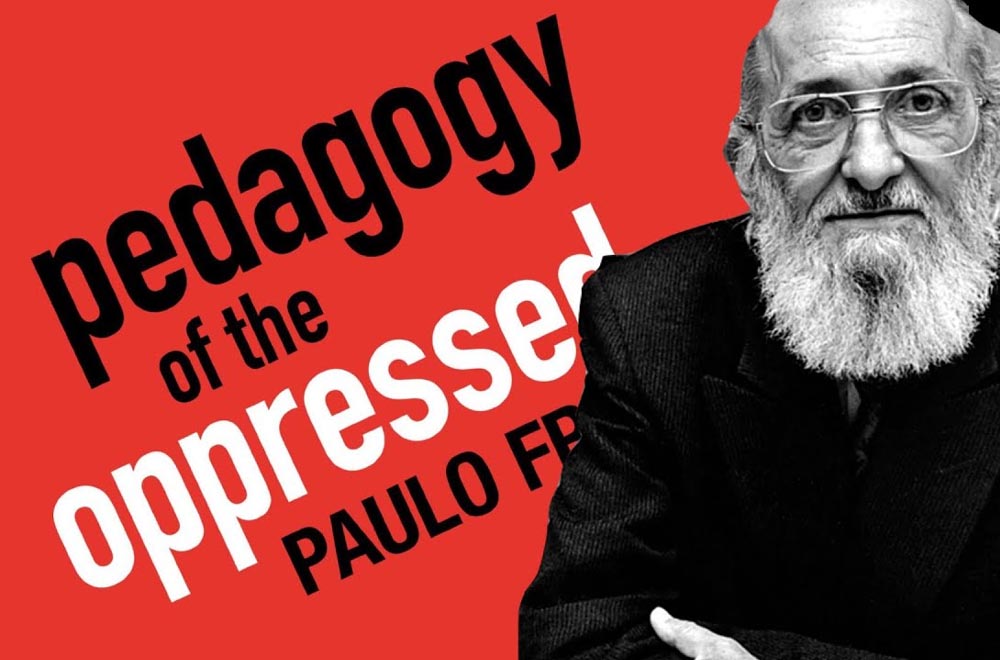
Paulo Freire authored many books one of those famous books is the “Pedagogy of the Oppressed”. He was born in Brazil in 1921 and was a pioneering proponent of critical pedagogy. He was also a leading as well as revolutionary educational philosopher of the twentieth century. He worked tirelessly to assist others, both via his revolutionary ideology and critical pedagogy practice. All these characteristics of Freire push one to study him either the reader is the student of politics or otherwise. Revolutionary spirit within the writer of this text has tried to help the readers to understand Paulo Freire in relatively simple terms.
“Without a sense of identity, there can be no real struggle.”
The Paulo Freire Institute introduces the Pedagogy of the Oppressed, saying that it gives the language to critically understand the tension, contradiction, fears, doubts, hopes, and “deferred” dreams that are part and parcel of living a borrowed and colonized cultural existence. It also gives the inner strength to begin the arduous process of transcending a colonial existence that is almost culturally schizophrenic: being present and yet not visible; being visible and yet not present. Paulo Freire’s critique of the dominant banking model of education leads to his democratic proposals of problem-posing education where “men and women come to see the world not as a static reality but as a reality in the process of transformation.” it is no wonder that his success in teaching Brazilian peasants how to read landed him in prison and led to a subsequent long and painful exile.
The ideas and activities of Brazilian educator Paulo Freire extended over a whole continent, having a tremendous influence not just in the sphere of education but also on the wider battle for national development. ‘Education is once again a subversive force,’ said Freire early exposure to low living led him to uncover what he refers to as the “culture of silence” of the destitute. He saw that their ignorance and laziness were a direct result of the whole position of economic, social, and political dominance, as well as the paternalism of which they were victims. Freire’s opinion is that every human being, no matter how “ignorant” or submerged, has a right to exist.
A neutral educational process does not exist. Education either acts as an instrument that is used to promote the integration of the younger generation into the logic of the system and bring about loyalty to it, or it becomes “the practice of freedom”. Freire then tackles potential objections to his work: his emphasis on freedom and oppression may be perceived as “idealistic” or “reactionary,” and others may reject his critiques of repressive structures. Given this, he believes the book’s core readership will be “radicals” motivated to change society. Freire contrasts radicals with “sectarianism,” an ideology that attempts to regard the universe as static and under control. Sectarianism can be right-wing or left-wing, but both hinder freedom by misrepresenting reality.
A radical, according to Freire, who is “dedicated to human liberation,” is willing to confront oppression, and works collaboratively with others. Instead of seeing themselves as the gatekeepers to freedom for the exploited, radicals struggle in solidarity with the oppressed. As a result, only radicals can affect the “pedagogy of the oppressed” that Freire will discuss in chapter 1. Freire then expresses optimism that readers will point out areas of his argument that might be improved and admits that he has never engaged in a political revolution—though he elaborates on revolution. At the very least, Freire believes that he conveys his confidence and faith in humans throughout the book.
Freire discusses what he terms “humankind’s core challenge” at the beginning off chapter one the problem of “humanization” (the inherent human impulse to confirm ourselves as human beings) and “dehumanisation,” which is historical oppression. Though both humanization are possible, humans naturally want to become more humanized, a process that is continuously disrupted by “injustice, exploitation, and violence.” dehumanization is not our fate as humans, but rather the result of an unjust social system. As a result, the most essential responsibility of oppressed people is to free themselves (as well as their Oppressors) from an unfair system. When Oppressors pretend to assist Oppressed people, Freire contends that they frequently hold a “false generosity” that relies on Oppression to function.
According to Freire, every movement to end injustice must be led by oppressed people. Oppressed people are the most familiar with the impacts of oppression, and their battle for humanity demonstrates how critical freedom is. However, at the beginning of this battle, Oppressed people sometimes act like Oppressors. According to Freire, an oppressive system mold’s Oppressed people’s views and leads them to feel that they, too, should become Oppressors. This implies that Oppressed individuals do not always identify themselves as “Oppressed,” holding to the “fear of freedom” mentioned in the introduction at first. According to Freire, the Oppressor-Oppressed relationship is one of “prescription”: Oppressed people behave in ways prescribed to them by their Oppressors. According to Freire, Oppressed people dread freedom because it forces them to reject their internalized values and actions. However, freedom is a permanent objective for everyone, “the essential precondition” for feeling whole as a human.
People must begin to realize the reasons for oppression to change their conditions and begin to build a new society. However, people must also address their internalized beliefs and concepts that restrict their freedom. According to Freire, “pedagogy of the oppressed” is the task of educating the oppressed in critically examining the nature of oppression and taking action to change their circumstances. This education should be directed, at least in part, by oppressed people, so that they can actively participate in their freedom. It is tough to begin the battle for freedom in this manner, for both oppressed people and oppressors who become conscious of their problematic position in society.
The outcomes of liberation should be double (and, according to Freire, dialectical): an objective change in how society operates and a subjective change in how individuals experience the world. Both are required because Freire regards people and the world as inextricably linked: human action produced our society, and human activities may change it in the future. These transformations are only possible through “praxis,” the mix of thought and action aimed at changing the environment. When only one of these events occurs, true liberation is impossible. According to Freire, oppressors use a variety of strategies to discourage oppressed people from critical reflection: if oppressed people recognize they live in an oppressive system, they will be more motivated to act against it. As a result, a pedagogy that promotes freedom should empower oppressed individuals to decide what is best for themselves.
Understanding the consciousnesses of Oppressors and Oppressed people, particularly the inner struggles of Oppressed people, is an important aspect of the first stage of Freire’s pedagogy. Oppression, according to Freire, is an act of exploitation, aggression, and a failure to “recognize others as humans.” Oppressors not only commit violence against the oppressed by preventing them from being fully human, but they also frequently label oppressed individuals as “aggressive” in response to Oppression. As a result, a liberation fight is an act of love, a desire to rebuild all people’s humanity. True freedom not only removes oppressors from power but also establishes a society in which the role of “Oppressor” does not exist, which will seem Oppressive to them.
When Oppressed people learn about the causes of Oppression and recognize that their Oppressors are powerless, they might begin to build confidence and conviction, according to Freire. This transition from passive tolerance to active engagement in the fight is an important aspect of the end of slavery. Along the journey, the Oppressed should engage in discussion with others to struggle for liberation collectively; when others try to liberate the Oppressed without their participation, they take away their agency, considering them “like objects that must be saved from a burning building.” leaders in the struggle must trust Oppressed people to reach their judgments. According to Freire, political leaders should approach liberation in a “Pedagogical” manner because educational approaches may be used to change the way Oppressed people think. However, if not done in collaboration with the exploited, it might resemble propaganda. Reflection and action must be undertaken together by leaders and the people.
Freire opens chapter two by explaining the qualities of a regular western classroom. He focuses on its “narrative” aspects: the teacher is a “narrating subject” with passive students. The teacher’s narration—or the information that he or she is teaching—is separated from the student’s life experiences, and students memorize these facts without understanding their entire meaning or context. Freire refers to this as the “banking” model of education, in which teachers “deposit” information into the minds of their students. He considers this strategy to be problematic since it suppresses creativity and does not inspire students to explore new questions through praxis.
For Freire, knowledge is the product of a never-ending process of questioning the world. However, the “banking” model views knowledge as something that instructors own and pupils do not. This attitude is intimately linked to oppression since it assumes that those without authority are uneducated. Then, Freire claims that his pedagogy, which aims to liberate oppressed people, must change the conflicting connection between instructors and pupils. Teachers have complete authority and influence over their pupils in this relationship.
The “banking” model shapes students’ mindsets by teaching them to accept the world as it is rather than questioning or attempting to change it. This benefits oppressor who want oppressed people to learn the actual nature of oppression. Oppressors, according to Freire, combine “banking” education with institutions such as welfare, which treat oppressed individuals as though they live outside of a normal, “healthy” society. Oppressed individuals cannot be “absorbed” into an oppressive society to be liberated; rather, they must completely restructure society. Education in “banking” overcomes this change by turning individuals into “automatons.”
Teachers who adopt the “banking” paradigm, whether aware of it or not, are unaware that it promotes oppression. However, Freire observes that some students may come to realize that their education is at odds with their inherent desire for liberty. Educators who sincerely want to help oppressed people, on the other hand, must collaborate with oppressed people as fellow students to achieve conscientizaço together. Through its ideas about people and the world, “banking” education hinders this process. People in the “banking” paradigm do not act on the world; instead, they exist in it and observe it. Teachers, on the other hand, have power over how their students see the world and train them to fit in.
The strategies used by instructors in the “banking” approach distance them from their students. In contrast, Freire advocates for true communication in the classroom, arguing that professors should not force their beliefs on students but rather work together with them. The “banking” paradigm, like oppression, is “necrophilia” and suffocates human existence. However, the suffering caused by injustice can motivate individuals to reclaim their independence and power. Freire describes the “banking” model as repressive to discourage revolutionary leaders from implementing it in the war for freedom. He observes that revolutionary leaders frequently use this model, but he pushes them to “reject the banking notion in its entirety” and replace it with a new model: the “problem-posing” model.
In contrast to “banking,” “problem-posing” education promotes human freedom through communication and dialogue. It changes the dynamic between students and teachers, transforming them into teacher-student and student-teacher relationships. Everyone in the classroom teaches and learns from one another. While the “banking” paradigm involves active professors and passive pupils, the “problem-posing” model transforms both groups into “co-investigators” who jointly challenge reality. Freire argues that the “problem-posing” methodology encourages students to develop critical awareness by using issues and situations that are relevant to their lives. This, in turn, motivates students to take action and confront the issues.
When education is geared to promote freedom, it regards humans and the planet as inextricably linked. Freire uses the example of a peasant student in a Chilean class who argues that human beings must exist in the world for it to be called a “world” in the first place—and compares the peasant’s point to French existentialist jean-Paul Sartre’s idea that human consciousness and the world are interdependent. “problem-posing” education assists people in developing their understanding of the world, allowing them to understand it as constantly changing. More broadly, Freire emphasizes that the purposes of “problem-posing” and “banking” are diametrically opposed. While “banking” disconnects individuals from history, “problem-posing” enables pupils to recognize their role in history.
Human beings are incomplete in the “problem-posing” model and are struggling to completely become themselves. This indicates that education is also a continuing activity, in contrast to the “banking” model’s lack of change. According to Freire, “problem-posing” is “revolutionary futurity,” since it is based on the optimism that oppression may be changed and conquered in the future. When oppressed individuals realize this, they may move from feeling defeated to feeling powerful. As a result, to achieve humanization, the liberation movement must defend oppressed people’s freedom to make decisions and ask questions for themselves. At every level of the process, it must rely on dialogue.
“Teachers and students (leadership and people), co-intent on reality, are both Subjects, not only in the task of unveiling that reality, and thereby coming to know it critically but in the task of re-creating that knowledge. As they attain this knowledge of reality through common reflection and action, they discover themselves as it’s permanent re-creators.”
Freire resumes his consideration of the dialogue from the previous chapter at the opening of chapter three. He claims that conversation consists essentially of “the word,” which he connects with praxis, the mix of thinking and action. When meditation is not accompanied by action, it is referred to as “verbalism,” and the term loses its potency. When action is not accompanied by thinking, it becomes “activism,” and people risk doing it without fully comprehending the implications of their actions. According to Freire, human life ultimately comes down to identifying and modifying the reality around us, and everyone should be able to begin this process. In these ideas, Freire defines dialogue, and he contends that discussion is required for humans to discover freedom and significance in their lives.
Dialogue, according to Freire, is an act of extreme love “for the world and people,” since it commits to giving individuals autonomy and agency while they study the world. Dialogue is also an act of humility since it disallows one individual to have power over another. Dialogue can only happen if each dialogue recognizes his or her flaws and recognizes that everyone has something meaningful to share. Finally, discourse is an act of faith: confidence in the ability of individuals to modify their surroundings and develop new ways of structuring society. This faith must account for oppressors’ efforts to keep oppressed people from wielding power. When done successfully, a discussion should result in mutual trust between the participants.
Finally, the discussion is impossible without optimism and critical thought. According to Freire, optimism stems from humans’ ongoing need to complete themselves, whereas critical thought stems from the desire to change reality. According to Freire’s pedagogy (the “problem-posing” paradigm), a conversation begins when the educator determines what he or she will discuss in the classroom. Dialogical education should focus on what students (or “student-teachers”) desire to learn while also engaging with what they already know. The “banking” approach aims to transform individuals, but the “problem-posing” model seeks to change the world alongside people: under Freire’s model, educators portray oppressive system aspects as “issues” that oppressed people then strive to solve.
Political leaders and educators should make an effort to comprehend both the actual conditions under which oppressed people live and how those people see those situations when they first start a conversation process. These situations are presented in the class as “issues,” which encourages the participants to make independent decisions and take independent action in each situation. Additionally, the language used in the lecture needs to be understandable and relevant to the students. A “problem-posing” classroom, according to Freire, should primarily concentrate on the “thematic universe” of its pupils. Freire then shifts gears to talk about this topic. Before providing a more detailed definition of the term, Freire rests his concept of “themes” on how people see the world and history.
Humans begin to grasp their relationship to the world when they realize they are constrained by their specific experiences in the world, which Freire refers to as “limit-situations.” limit circumstances are historical, which means they are not permanent and may be overcome. In turn, Freire considers history to be the product of praxis, or reflecting and acting on reality to change it. He divides history into “epochs,” or periods marked by people’s thoughts, values, and beliefs of the time. These ideas and beliefs exist in the world, and Freire refers to their expression as “themes.” every topic has an alternative word that represents an opposing thought or opinion.
Humans begin to grasp their relationship to the world when they realize they are bounded by their specific experiences in the world, which Freire refers to as “limit-situations.” limit circumstances are historical, which means they are not permanent and may be overcome. In turn, Freire considers history to be the product of praxis, or reflecting and acting on reality to change it. He divides history into “epochs,” or periods marked by people’s thoughts, values, and beliefs of the time. These ideas and beliefs exist in the world, and Freire refers to their expression as “themes.” every topic has an alternative word that represents an opposing thought or opinion. Themes can exist on multiple levels and even if individuals are unaware of them.
The thematic study begins with educators identifying a workplace and beginning to examine it and its inhabitants. Freire offers an adult education class “in a peasant region with a high percentage of illiteracy” as an example. The educators should observe many elements of the peasants’ life, communicate with them, and recruit them as volunteers. Working together, the educators and peasants identify the most critical circumstances impacting the peasants, and then determine whether the peasants are aware of the area’s limit-situations and themes. The educators then utilize visual, aural, or tactile resources to portray the limit-situations and themes, which Freire refers to as “codifications.” the codifications should be clear and understandable to peasants, but they should also push them to do their analysis. Freire quotes a Chilean teacher who used “decoding” in his classroom to help his students become more critical thinkers. The codifications should be clear and understandable to peasants, but they should also push them to do their analysis. Freire quotes a Chilean teacher who used “decoding” in his classroom to help his students become more critical thinkers.
As the peasants and educators examine the materials together, they reflect on each circumstance and their reactions to it. Rather than favoring their viewpoint above the peasants’, educators must enable the peasants to openly express how the conditions make them feel. Freire cites the example of a “codification” of alcoholism—while the educator may consider it as absolutely terrible, the peasant may recognize himself as someone who drinks to deal with unpleasant work. Throughout this process, the educators listen to and document the comments, and finally begin to examine them to uncover the themes they outlined before. Eventually, the educators utilize the data to create new lesson materials, which they offer to the peasants as part of a more structured curriculum. This curriculum is the result of educators’ study and represents the areas that peasants are most interested in. Most significantly, this curriculum gives peasants authority and allows them to think for themselves.
“One cannot conceive of objectivity without subjectivity.”